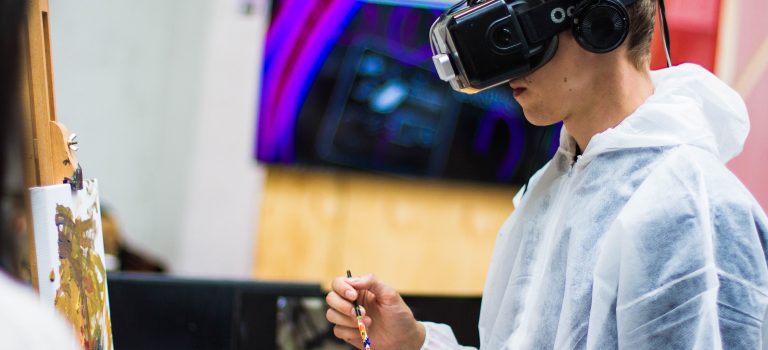
Historically, art and technology are separately boxed by our education system and ideological gap between the two is undeniable. However, such interdisciplinary programs are not completely absent from the academic world. There has been much discussion over last decades about how STEM education needs to expand to STEAM, incorporating art and creative thinking into more right-brained areas of innovation. Aware that art can spark an excitement about learning that goes beyond the artistic to embrace science, math, technology, and engineering, prominent tech and science schools like the Massachusetts Institute of Technology, New York University and Carnegie Mellon have integrated design and arts education into their curricula. As is true in the best learning moments, a connection to art can ignite the drive for more learning across disciplines, more creativity and motivate students to continue seeking new solutions.
Last year, one of the world’s most prestigious art schools, The Royal College of Art in London, announced plans to expand its curriculum in order to transform the accepted paradigm of an art and design university, by injecting key scientific disciplines into the mix of creative courses traditionally on offer. RCA’s new ambitious five-year campaign programme, named GenerationRCA, sends a clear message that today’s designers must be trained to tackle larger interdisciplinary issues. The world is too complex and interconnected for designers to not be proficient in a variety of disciplines, from traditional craft-based skills to the science and technology that are an integral part of our daily lives.
As announced, the RCA will continue along its recent path of introducing exciting and provocative new programmes such as Environmental Architecture, a year-long masters that focuses on the city from a sustainability perspective, and Digital Direction, another year-long program that concentrates on digital storytelling in the creative economy. In the meantime, future programmes will center on nano and soft robotics, computer science and machine learning, materials science and the circular economy.
According to vice chancellor Paul Thompson, the launch of the GenerationRCA is the most significant development in its 182-year history. “Founded in response to the first Industrial Revolution, today the RCA stands as the vanguard of a new era in art and design, which promises breakthroughs in robotics, autonomous vehicles, nanotechnology, and artificial intelligence,” he said. This watershed moment reveals that some art educators finally understand that science and technology need to be part of the curriculum in order for art schools to survive the digital age.
But so far, the science sector has been more open to welcoming art than the reverse. Although there are art and design schools that do digital arts education well, like UCLA’s Design Media Arts curriculum, which uses technology-powered art processes, very rarely a traditional school adopts science and technology as a core focus.
Despite the many possibilities that science and technology present, few art programmes embrace the new paradigm. It is noticed that art teachers are often reluctant to implement computer technology in art education, either because they don’t have the skills to use the technology or because they prefer the traditional approach and techniques. According to the 2019 State of Art Education Survey, 52.2 percent of art teachers want to learn more about teaching digital art effectively, but only 21.9 percent of art teachers feel comfortable actually teaching a digital arts curriculum. Some traditional creatives are not only unsure how to integrate technology into their teaching, but also hesitant to see coding and other technology-led processes as artistic practices.
Prof. Mick Grierson, a research leader at the newly opened Creative Computing Institute at the University of the Arts London, admits, “There are plenty of people who, for decades, have been in the art and design community but haven’t really been able to find a home for their technology-led creations and practice,” he says. “So of course, they naturally migrated to a STEM environment because it’s easier for them to talk about the materials they use and the approaches they take.” “It’s like the art school has handed the baton of creativity over to the computer scientists and programmers, who often make terrible art,” echoes digital artist Alan Warburton.
Back in 1990, Deborah Greh, St. John’s University educator, clarified that using technology as a tool to develop art works should not overshadow art principles, concepts and techniques. Too often artists are enchanted by the novelty of the tool itself, its formal and aesthetic possibilities, so they sacrifice substance in the process, neglecting the fact that art needs something to day. It doesn’t really matter, if a work of art is analog or digital – the qualities that make it meaningful remain the same, and that is something only art schools can teach.
Today, digital art still is not treated as seriously as analog art, and experts admit, universities will need to adopt an even broader shift in thinking to change that.
“The biggest problem that digital art forms have faced is that scarcity equals value, and being readily available means these works essentially are worthless,” says Grierson. This is echoed by digital artist and educator Vicki Fong, who believes that digital art is often perceived as being more about production. “People are using digital skills to speed up the process, so more art is being made at a much quicker rate, which doesn’t necessarily increase the quality,” she says. All this is the negative impact of the traditional creatives and art educators being slow to embrace computerized art and admit that it should belong to the realm of art rather than STEM environment.
Predictably, artists won’t just naturally begin incorporating technology into their work without schools teaching them how. As curator Julia Kaganskiy told Artnet, to succeed in technology-led art teaching schools should integrate both technological thinking and practice. “As software, algorithms, non-conscious cognitive agents and cybernetic thinking increasingly shape the world around us, artists need to have a strong grasp of the practical and philosophical implications of this transformation,” she says. “I’m not saying that every artist needs to learn to code, but they should probably read some media theory and software studies texts, maybe even some posthumanist philosophy.”
The process of integration of science and technology into the art school curriculum still has a long way to go. As technology infiltrates every element of our life, educators need to do more than just prep students with basic graphic software. One thing is clear: the artists and designers who embrace technology as part of their art training will no doubt be more in demand than those who do not.