





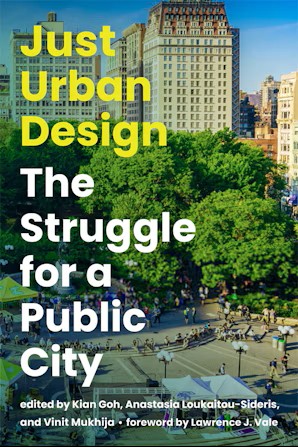
Just Urban Design: The Struggle for a Public City asks a direct but often neglected question: what would it mean to place justice at the centre of urban design? Edited by Kian Goh, Anastasia Loukaitou-Sideris and Vinit Mukhija, the collection brings together urban planners, architects, landscape architects, sociologists and anthropologists to examine how decisions about space distribute access, safety, visibility and opportunity.
The contributors address public space, mobility, housing, informality, community development and climate change. Across these subjects, the book challenges the idea that urban design is primarily a matter of physical form. Streets, parks, housing and infrastructure are also shaped by power: by who participates in decisions, whose needs are recognised and who is able to remain in a neighbourhood after it improves.
For students, this creates a valuable framework for assessing projects beyond their visual qualities. A well-designed place can still exclude people through cost, surveillance, displacement or limited access. The book therefore treats community participation and organising not as optional consultation, but as essential parts of creating more equitable urban environments.
At BE OPEN Academy, Just Urban Design works particularly well as a deeper review because it connects creative practice with public responsibility. It does not offer one universal model for the fair city. Instead, it asks designers to recognise conflict, listen to those most affected by change and consider how the built environment can support a genuinely public city. The open-access edition also makes this important discussion available to students and educators worldwide.
Find out more about Just Urban Design: The Struggle for a Public City →