




Criticizing design education has become a popular trend these days. It is often accused of being costly and irrelevant and its value and validity are called in question. Some of the accusations are not baseless. The whole design field is going through major transformations, and educational institutions appear not to pull their weight. Still, as the industry works through its growing pains, the importance of design education seems to be greater than ever.
With tuition costs constantly rising, young people who wish to pursue a career in design – i.e. a broad range of disciplines loosely related to graphic, communication, and UX design – more often than not think of skipping school and foregoing a traditional bachelor’s degree program in favor of a crash online course or the classic school of life. Their reasoning is understandable. Unlike a med school or a degree programme in STEM with their linear course of learning where students are taught facts and procedures in preparation for passing a series of exams, the path of a design student is much more complex. Every school has its own approach, and it makes impossible to quantify the ROI of the design degree costs and estimate the actual job preparedness of a recent design graduate.
But what if we change a perspective and reflect on design universities as spaces where future designers can thrive on the luxury of learning, cultivating innovation and ambition? To determine if tuition costs are appropriate, it is essential to consider what a student gains from the experience – and in case with the design school it is not solely about skills and knowledge, it is about an access to an environment that is not easily found elsewhere.
According to Abbott Miller, partner of Pentagram, “What you’re buying in design education is not an imprimatur to get a job. It is a face-to-face, collaborative experience in a real physical space.”
Of course, design school is not the only place to get professional mentorship, but it is really the most obvious way. Operating designers set client briefs for students in traditional universities, design gurus visit as guest lecturers and even teach as professors. This generous resource could be not available elsewhere for a new designer in the industry. On the contrary, agencies often do not allow young designers to present their work and have poor internal communications in general.
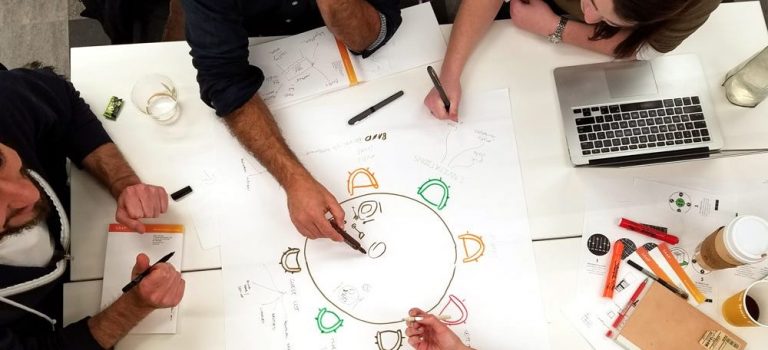
Teamwork during the years of study is also crucial. The shared experiences and growth while studying can build long-lasting relationships among peers and bring fruit in the future.
Within this context, the importance of design education is in providing a framework for practicing soft skills, such as adaptability, ability to work in a team, social intelligence, and good communication, which according to the recent Forbes survey involving hundreds of companies, rank the highest among top qualities that companies are looking for in future hires. All these traits can be learned through design education with its system of design critiques, student presentations, and team projects, which occur in safe environment and with respect for young designers’ delicate egos.
Design schools also allows students unconstrained freedom of experimentation across all levels. First, it provides access to numerous resources that can be quite costly without a student pass, such as letterpress facilities, computer programs, and photography studios, which are generally free for students. Secondly, while the majority of designers will begin a career restricted to client deadlines and production requirements, design school is a safe space where creativity is not hindered by budgets and clients’ whims. This immunity to real-world restrictions sets a foundation to the mindset of the future designer who is expected to generate innovation and impact in their work.
Speaking of the job market, the mindset in future-facing companies is shifting. The role of the designer is no longer a supporting role — it is one that leads. In this respect, formal design education involves preparing students to become great problem solvers, ready to deal with today’s large, complex problems.
From this prospective, to shape the curriculum as a standardized application-oriented, ready-for-the-job set of tools and skills would be a limiting strategy. Many popular professions of today were completely unheard of 10 years ago. Following this trend, today’s computer programs will soon be outdated and familiar design processes will be reimagined, so it is natural that businesses want to prepare. Within the context of such an uncertain future, it is vital that the new generation of designers is equipped with skills that can empower them to manage complex and unfamiliar conditions with ease and confidence.
And here is where formal design education steps in. Traditional educational institutions aim to teach students to think critically, be observant and resourceful. When it comes to real-world skills, a design school isn’t out of date, it is timeless, for its key value is that of learning how to learn. It is only challenging the status quo that can lead the industry into the future.
Sure enough, there is a lot of things that can be improved and amplified in traditional design schools to make students better prepared for the real world of design careers. However, in this era of seismic shifts in the design industry, formal design education seems to be more important than ever. It teaches future designers a mindset and attitude towards life itself and empowers them to reach their full potential in creativity, self-efficacy, and collaboration. One should be ready to disrupt the routine to be able to change the world. Perhaps design education is the answer.