




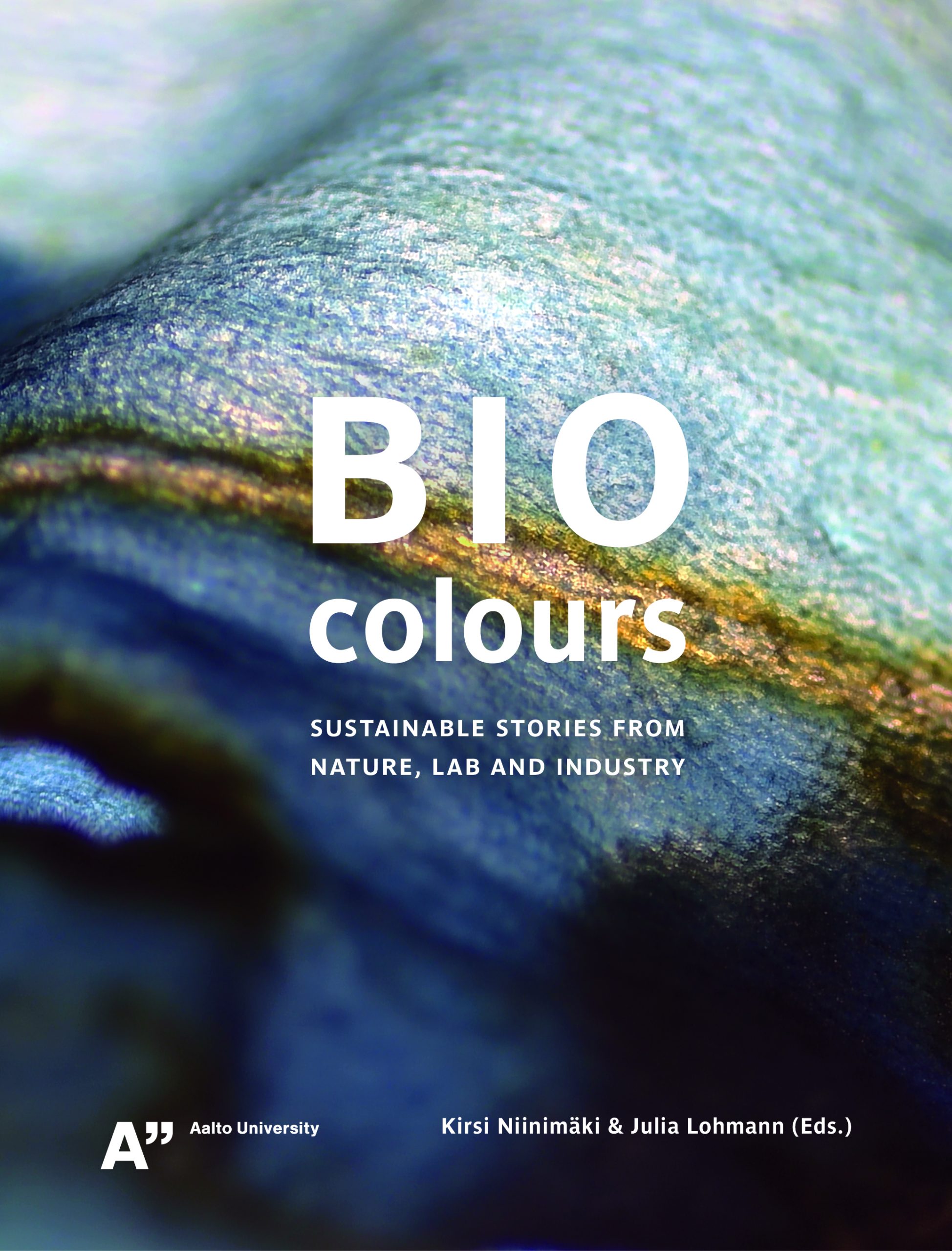
What does a colour tell us about the conditions in which it was made? BioColours, edited by Kirsi Niinimäki and Julia Lohmann, approaches that question through chemistry, cultivation, design research and artistic practice. Its three sections—foundations, narratives, and sustainability and applications—bring different kinds of evidence into conversation. Colour becomes a way of investigating how a material connects to a landscape, a production system and the people who use it.
The range of approaches is one of the book’s strengths. Research on microbial colour production sits alongside accounts of dyeing as a situated craft. In Fieldnotes from the “forbidden garden”, Siren Elise Wilhelmsen explores the dye potential of Japanese knotweed in Norway, connecting material experiments with the history of her grandmother’s garden. The plant’s usefulness and its status as an invasive species remain in tension. That tension makes the case more instructive than a simple celebration of an abundant natural resource.
The chapters on sustainability and colourant performance give this experimentation a necessary technical context. How a colour is extracted, fixed to a fibre and maintained in use matters alongside its origin. A reader is encouraged to examine safety, durability and production requirements before accepting an environmental claim. These are practical questions for a designer deciding whether an attractive sample is appropriate for a particular application.
The volume requires readers to move between scientific explanation, personal narrative and design speculation; it offers no single route from a dye source to a finished product. Its value for students lies in learning to compare those perspectives. Read in that way, BioColours helps turn enthusiasm for a new material into a better research question: what would have to be known, tested and changed for this colour to support a responsible creative practice?
Find out more about BioColours: Sustainable Stories from Nature, Lab and Industry →