




BOA added 2 new online courses in Web and Data Design from London Academy of IT
Month: September 2021

BE OPEN: How the Pandemic Changed Higher Education
The coronavirus pandemic brought unexpected and significant disruption to the many spheres of our lives. The last year and a half have seen empty campuses and a precipitant shift towards e-learning among other efforts of the higher educational sector to survive in these turbulent times. While some experts predict a mass extinction of colleges and universities as we know them following the crisis, it is not all that doom and gloom. Sure enough, it would be naïve to expect higher education to return to pre-pandemic normal, but certain positive changes are here to stay.
The main positive shift is likely to be around online teaching. Although some universities struggled to deliver quality online classes, this new approach to learning will most probably be a permanent solution. Recent surveys show that although most students desire a return to in-person learning, the majority also want to continue having the option to take classes online. Driven by student demand, most higher educational institutions are planning to offer various options for fully online and hybrid learning that will combine the flexibility of online lectures with more interactive activities in-person, such as labs, seminars, workshops and Q&A sessions.
The colleges are aware of the skepticism expressed by some of the students who are concerned about whether online teaching means they are getting worse value for money. Addressing the issue, Prof Allison Littlejohn, an academic at UCL specialising in learning technology, explains that “the time needed to prepare and produce online teaching materials is much higher than for on-campus lectures.”
Instead, most universities are shifting lectures online and even go that far as talking about ending face-to-face lectures altogether. What it actually means is not foregoing any in-person classes for the students but rather replacing large lectures of 200 students upwards with online sessions that proved to be far more effective during the pandemic.
One of the main positive lessons that can be drawn from the crisis has to do with prioritizing building the virtual infrastructure over long-standing emphasis on building the physical infrastructure of college campuses. According to The World Economic Forum,“before the pandemic, the online learning environment existed predominantly as a virtual filing cabinet… The pandemic has illuminated what can be done with this online space: it can be engaging, enriching and accessible”.
44% of student respondents to a recent QS survey reveal they are open to the idea of attaining their degree via online means, which is a larger number than ever before. This brings most universities to think about including more online degree and non-degree programs into their offer as well as develop related virtual student services.
For example, it will most likely become a norm to keep lectures video recorded and available online at any time for the students to review, even for in-person classes. This is what 79% of college students wished to see continue, when asked what new services and approaches they would like to maintain once the pandemic is over.
So, what else can help universities to reimagine their offerings and move to a new higher education paradigm that can equip students with skills required for the 21st century employment market? The authors of the research article, Forever Changed! Innovation and the Future Post-Covid Higher Education Landscape, Professor Jerry Yoram Wind and CEO of QS, Nunzio Quacquarelli, suggest a major transformation of current pedagogical approaches. According to them, embracing technology as part of the teaching process will allow for much sought-after personalization and flexibility, as well as bring in numerous innovative ways to enhance learning, such as augmented or virtual reality for experiential learning and gamification to serve the new generation of Zoomers.
Ever-growing use of e-learning has another positive impact on higher education. If in the past, universities and colleges paid more lip services to diversity, equity and inclusion (DEI) metrics, today online learning has made education accessible to those who are not able to attend traditional learning programs. For example, there is strong evidence that non-white students greatly prefer online education models as well as virtual internships and jobs over white students. Higher educational institutions will need to make real commitments to DEI because many constituents will begin holding them accountable to their progress.
According to Forbes, the formal education system will experience fundamental change. To serve a growing market of value-oriented prospective students, traditional schools will be forced to launch lower-cost online degrees, which will result in a new kind of price war in higher education.
Relatedly, experts believe that elite colleges and universities, which are often unwilling to grow enrollments, admit more unprivileged applicants and minorities, and are slow to introduce innovative and non-traditional teaching methods in an attempt to keep their authenticity, will no longer be role models in the higher education sector. Instead, the field will see the rise of “public flagships and up-and-comer privates that innovate on many dimensions, find ways to freeze or lower costs, and dedicate themselves to being student- and employer-centric.”
Speaking of employers, they too are expected to offer an alternative to residential 4-year degrees, thus weakening the market of traditional higher education. On the one hand, following the example of Google who started treating their tech certificates as equivalent to degrees in the hiring process, many companies now offer their own non-degree education and non-traditional degrees. On the other hand, employers will continue to invest in education-as-a-benefit programs where they provide financial support to employees seeking degrees.
The future will tell what of the predictions will prove to be true.
BE OPEN Academy Poll. Best Offline Course in Advertising taught in a US University
Advertising Design programme offered by College For Creative Studies, Detroit, Michigan, has won in our online pole about the best offline course in Advertising taught in a US University. Students learn to devise advertising strategies — based on research and consumer insights — that integrate digital and social media, content creation and user experience, print and television.
The other entries in the pole were:
- Advertising and Digital Design offered by Fashion Institute of Technology, NYC, New York
- Advertising MFA offered by Savannah College of Art and Design, Savannah and Atlanta, Georgia
- Advertising offered by School of Visual Arts, NYC, New York
- Advertising & Graphic Design offered by Columbus College of Art & Design, Columbus
Update: BOA added 2 new online courses in Web Development offered by Academy for Health & Fitness
BOA added 2 new online courses in Web Development offered by Academy for Health & Fitness
BE OPEN Academy Poll. Best Offline Course in Ceramics
Ceramics MFA taught in Rhode Island School of Design (RISD), USA, has won in our online pole about the best offline course in Ceramics. This studio-based programme offers a contemporary, urban context for rigorous investigation and dialogue in support of individual artistic development.
The other contestants in the pole were:
- Ceramic Art taught in University of Gothenburg, Sweden
- Ceramics Design taught in Stroganov Moscow State Academy of Arts and Industry, Russia
- Ceramics and Porcelain taught in Academy of Arts, Architecture and Design in Prague, Czech Republic
- Ceramic Arts and Design taught in Seoul National University of Science and Technology, South Korea
Update: BOA added 3 new offline courses in Technical University of Valencia
BOA added 3 new offline courses in Technical University of Valencia
Update: BOA added 11 new offline courses offered by Nelson Mandela University
BOA added 11 new offline courses offered by Nelson Mandela University
Update: BOA added 7 video tutorials on UX Design by The Future
BOA added 7 video tutorials on UX Design by The Future
BE OPEN: Why Design Education Is Important
Criticizing design education has become a popular trend these days. It is often accused of being costly and irrelevant and its value and validity are called in question. Some of the accusations are not baseless. The whole design field is going through major transformations, and educational institutions appear not to pull their weight. Still, as the industry works through its growing pains, the importance of design education seems to be greater than ever.
With tuition costs constantly rising, young people who wish to pursue a career in design – i.e. a broad range of disciplines loosely related to graphic, communication, and UX design – more often than not think of skipping school and foregoing a traditional bachelor’s degree program in favor of a crash online course or the classic school of life. Their reasoning is understandable. Unlike a med school or a degree programme in STEM with their linear course of learning where students are taught facts and procedures in preparation for passing a series of exams, the path of a design student is much more complex. Every school has its own approach, and it makes impossible to quantify the ROI of the design degree costs and estimate the actual job preparedness of a recent design graduate.
But what if we change a perspective and reflect on design universities as spaces where future designers can thrive on the luxury of learning, cultivating innovation and ambition? To determine if tuition costs are appropriate, it is essential to consider what a student gains from the experience – and in case with the design school it is not solely about skills and knowledge, it is about an access to an environment that is not easily found elsewhere.
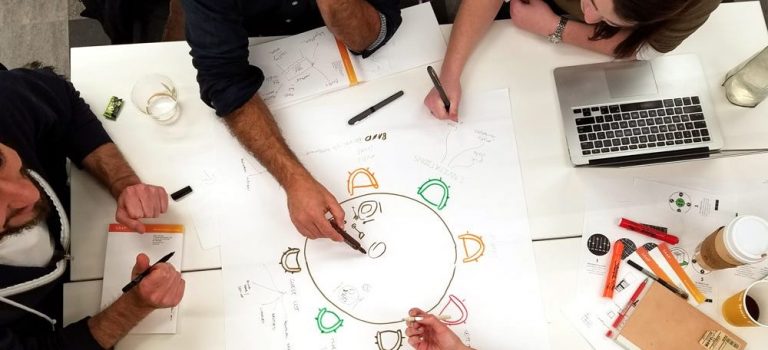
According to Abbott Miller, partner of Pentagram, “What you’re buying in design education is not an imprimatur to get a job. It is a face-to-face, collaborative experience in a real physical space.”
Of course, design school is not the only place to get professional mentorship, but it is really the most obvious way. Operating designers set client briefs for students in traditional universities, design gurus visit as guest lecturers and even teach as professors. This generous resource could be not available elsewhere for a new designer in the industry. On the contrary, agencies often do not allow young designers to present their work and have poor internal communications in general.
Teamwork during the years of study is also crucial. The shared experiences and growth while studying can build long-lasting relationships among peers and bring fruit in the future.
Within this context, the importance of design education is in providing a framework for practicing soft skills, such as adaptability, ability to work in a team, social intelligence, and good communication, which according to the recent Forbes survey involving hundreds of companies, rank the highest among top qualities that companies are looking for in future hires. All these traits can be learned through design education with its system of design critiques, student presentations, and team projects, which occur in safe environment and with respect for young designers’ delicate egos.
Design schools also allows students unconstrained freedom of experimentation across all levels. First, it provides access to numerous resources that can be quite costly without a student pass, such as letterpress facilities, computer programs, and photography studios, which are generally free for students. Secondly, while the majority of designers will begin a career restricted to client deadlines and production requirements, design school is a safe space where creativity is not hindered by budgets and clients’ whims. This immunity to real-world restrictions sets a foundation to the mindset of the future designer who is expected to generate innovation and impact in their work.
Speaking of the job market, the mindset in future-facing companies is shifting. The role of the designer is no longer a supporting role — it is one that leads. In this respect, formal design education involves preparing students to become great problem solvers, ready to deal with today’s large, complex problems.
From this prospective, to shape the curriculum as a standardized application-oriented, ready-for-the-job set of tools and skills would be a limiting strategy. Many popular professions of today were completely unheard of 10 years ago. Following this trend, today’s computer programs will soon be outdated and familiar design processes will be reimagined, so it is natural that businesses want to prepare. Within the context of such an uncertain future, it is vital that the new generation of designers is equipped with skills that can empower them to manage complex and unfamiliar conditions with ease and confidence.
And here is where formal design education steps in. Traditional educational institutions aim to teach students to think critically, be observant and resourceful. When it comes to real-world skills, a design school isn’t out of date, it is timeless, for its key value is that of learning how to learn. It is only challenging the status quo that can lead the industry into the future.
Sure enough, there is a lot of things that can be improved and amplified in traditional design schools to make students better prepared for the real world of design careers. However, in this era of seismic shifts in the design industry, formal design education seems to be more important than ever. It teaches future designers a mindset and attitude towards life itself and empowers them to reach their full potential in creativity, self-efficacy, and collaboration. One should be ready to disrupt the routine to be able to change the world. Perhaps design education is the answer.
BE OPEN Academy Poll. Best Online Course in Character Design
How To Draw Cartoon Characters course offered by Skill Success has won in our online pole about the best online course in Character Design. In this course, you will learn the process of designing and drawing cartoony characters in both stylized and classical styles.
The other entries in the pole were:
- Character Design offered by Study365
- Design 2D Game Characters With Inkscape offered by One Education
- Character Design for Video Games offered by California Institute of the Arts
- Drawing Cartoon Characters offered by Janets