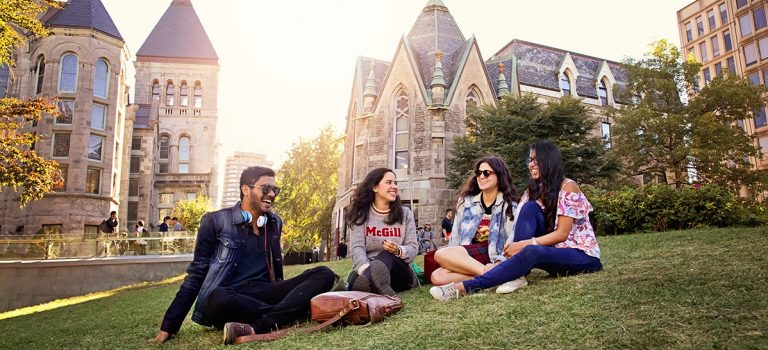
Traditionally, campus is perceived to be ‘the face of the university’, and the very idea of ‘going to the university’ is connected in our mind to the image of the campus as a physical place. However, given all the debate of the value of ‘traditional’ university education today, little is said about the value of campus life. There is every reason to believe that the impact of higher education increases dramatically when students in the university live on or attend campus offering a robust campus life program and an opportunity to interact with a range of people and ideas.
The emergence of the campus can be traced back to the universities of medieval Europe where scholarly exchanges occurred in intimate cloistered settings. Since then, universities created a strong relationship between learning and physical place, with campus being a space that gives meaning to the learning process. Today, it is still a setting that provides the opportunity for social and intellectual interaction with a scholarly community as well as a place that engenders knowledge, self-discovery and personal transformation.
Dr Sarah French and Professor Gregor Kennedy of Melbourne Centre for the Study of Higher Education point it out, that over the course of the twentieth century the role of the campus underwent a series of transitions. Universities gradually became less elite and more inclusive as student populations expanded beyond the demographic of the white upper-class male. To accommodate expanding student numbers, they became increasingly larger in scale.
On the other hand, with the advance of distant education and online learning as well as development of social networks into informal learning communities, it became possible for students to study without physically attending a campus. The historical role of the campus was therefore displaced, giving way to non-campus based forms of learning. As a result, the pattern of students participation is changed correspondingly. According to the studies conducted by the Melbourne Centre for the Study of Higher Education, university students are attending campus less and choosing online modes of learning more due to the availability of online resources such as lecture recordings and class notes, and the increased number of hours students spend in paid employment and family commitments. To put it short, modern students are viewing physical attendance at campus more as an option than a necessity.
However, as Dr. Loren Rullman, Vice Provost for Student Affairs and Dean of Students at Grand Valley State University, perfectly puts it: ‘Going to a football game is very different than watching it on television, and experiencing new music, food, people, languages, music and ideas is very different than simply reading about them.’ As some formal learning activities move online, the reasons that students attend campus are changing too, mainly centering on opportunities to engage with academic staff directly, to participate in collaborative and interactive learning with peers and to be involved in social networks and activities.
The changing educational environment has prompted universities of the 21st century to reconsider the role of the physical campus and redefine the campus experience. In his provocative report on the issues facing Canadian universities today, Stephen J. Toope argues that students will only continue to attend campus if two conditions are met: first, the university must have a superior reputation or ‘brand,’ and second, the university must create an on-campus experience that is ‘so rich and unique that students feel drawn to participate actively’. Dr French and Professor Kennedy refer to University Trends: Contemporary Campus Design by Coulson, Roberts and Taylor, saying that the past decade has seen extensive interest in the physical spaces of universities within the fields of architecture and design.
There is a reverse side of the coin, as Dr. Rullman highights. With media constantly reporting about higher education spending on lavish campus facilities in recent years, campus today is often associated with “luxury dorms” or “amazing recreation centers,” and other seemingly excessive amenities. This makes one think that students are only attracted to luxurious campus facilities and that universities are motivated solely by the pressure of an amenities arms race.
Rullman emphasizes that to improve value for students and their families and aid public understanding, colleges and universities must insist on educational and institutional outcomes for facility development, having a clear picture of how the creation of new recreation centers, student center buildings, student success offices and similar facilities will contribute to the sum of a student’s education. “They do not replace what is in the classroom, and they should not be the primary reason a student selects a college. Most important, they must be responsibly developed to serve the institution’s mission,” he goes on.
Put it another way, newly designed university buildings and campus spaces should reflect key shifts in approaches to teaching and learning. For example, as lecture-based teaching methods have become less dominant and collaborative learning more prominent, new campus designs should include fewer lecture theatres and more spaces designed for conversation and interaction.
So what are the real reasons why colleges and universities should invest in their facilities? What is the true value of campus these days?
In their eponymous article, Dr Sarah French and Professor Gregor Kennedy centre around six broad interrelated areas:
- involvement in a scholarly community
- face-to-face interaction with academic staff
- opportunities to engage with campus-based modes of teaching and learning
- opportunities for collaborative, interactive and informal learning
- opportunities for student engagement through participation in extra-curricular activities
- opportunities for social contact and developing friendships.
According to the authors, ‘coming to campus provides students with the opportunity to be immersed in an intellectual culture, to gain expert knowledge from scholars and to explore ideas with peers <…> Aspects such as an institution’s architectural history, contemporary design features, landscaping, and the provision of accessible and appealing spaces in libraries, cafes and outdoor areas can all enhance the sense of involvement in a scholarly community.’ But what is more important, being on campus allows students to interact with academic staff benefiting from their expertise in specific disciplinary areas. Quality feedback and advice from scholars can often be more effectively delivered in face-to-face discussions rather than in written or online formats.
Adam Weinberg, president of Denison University, supports this opinion, as he explains how students might benefit from mentorship on campus. Student development staff, such as deans, health and counseling professionals, push students to get outside their comfort zones, to listen and hear other students, to reflect on their own world views and choices, and to learn. This happens when students come into their offices, when they supervise student employees, in meetings with student organizations, and when they bump into students walking around campus.
Weinberg also quotes the book How College Works by Dan Chambliss and Christopher Takacs, which presents research from a ten-year study of 100 students to learn what makes a successful college experience. They write, that mentors “shape in detail a student’s experience: what courses they take or majors they declare; whether they play a sport or join an extracurricular activity; whether they gain skills, grow ethically, or learn whatever is offered in various programs.” Simply put, mentoring relationships “raise or suppress the motivation to learn.”
Speaking of opportunities for interactive and informal learning, Peter Jamieson argues that the entire campus should be viewed as a learning space. Outside the classroom, campus spaces should foster face-to-face communication, conversation and interaction between students in informal settings, which develops such skills as problem solving and critical thinking as well as values and habits students will need as adults.
As Weinberg put its, ‘the learning happens everywhere in formal and informal ways. For example, residential halls become places where students take what they are learning in classrooms and use it to learn to live and work with a diverse array of people in an ever-changing environment.’
Weinberg also connects campus experience and success in life. In his article he cites the research by the Gallup organization (presented in the Gallup-Purdue Index) which finds participation in extra-curricular activities and other activities outside the classroom to be one of the most significant predictors of success. “Students need to develop a broad array of soft and hard skills. No single curriculum can do it all. There is too much to learn and too few classes and courses to teach it all. Campus life is crucial to closing the gaps between what we teach in the curriculum and what students need to succeed,” Weinberg advises.
Indeed, the campus experience provides opportunities for an extensive range of academic, co-curricular and social forms of engagement. Activities organized by universities include orientation programs, competitions, workshops, public presentations, career information sessions, leadership and mentoring programs, engagements with workplace and industry and internships. Equally, student-led activities provide important opportunities for students to be involved in clubs and societies, sporting activities, the performing arts and music, creative writing, journalism, student politics and various other activities that can cultivate skills in areas such as leadership and communication. Students who take on a leadership role in a campus organization face all the usual management challenges in the workplace and in civic life that will help them build leadership in the future ‘grown-up’ lives.
Last but not least are social possibilities of on-campus study. Significant number of people report than they have met their spouse and closets friends at university. The same is true about collegial networks cultivated by social encounters while studying, which often prove to be valuable in the workplace.
To sum it up, campus-based education is a great way for students to learn to voice views, hear others, and understand how to work together to create the communities they want to live in. Some campus facilities are designed to expose students to people with different backgrounds and ideas that may be new to them, others offer spaces for them to learn about organizing people and managing meetings, while the third are entirely educational. “Recreation facilities, dining centers, cultural spaces and the like give students opportunities to practice, make mistakes, form opinions, explore values and learn, lead and follow,” writes Rullman. “These facilities are worthy of investment because student learning is worthy of investment.”