




Update: BOA added 7 free video tutorials offered by FZDSCHOOL
Month: September 2023

BE OPEN: Best Art School Alternatives: Affordable & Accessible Education
A school of art teaches you technical and creative skills, the business side of art, networking, and how to develop an artist’s attitude. These things are hard to learn on your own and require guidance from people with experience in careers in art.
Pros and Cons of Formal School
There are pros and cons of attending a school of art.
Pros:
- Discipline: The demands of deadlines teach you to develop a habit of consistent work
- Mentors: Good instructors help you develop your strengths and minimize weaknesses
- Networking: Making acquaintances, both students and teachers, can build a network for later support and opportunities
Cons:
- Cost: Tuition is the biggest drawback. Good schools of art aren’t cheap, and loans can leave you with student debt that alternative schools don’t
- Pressure: While deadlines can help you to build discipline, they can also take some or all the fun out of art making
- Prescribed Curriculum: You are stuck with the knowledge and skills the school thinks you should learn and how you should learn them, like doing research projects
Can You Be an Artist Without Going to School?
You can become an artist without going to a school of art. If you are a self-starter, disciplined, and have a passion for art, you have a good chance of becoming a professional artist.
By art school, we mean any commercial program that offers a structured curriculum and feedback, whether online or in person. Self-taught means you read and research techniques in books and online and practice under your own direction.
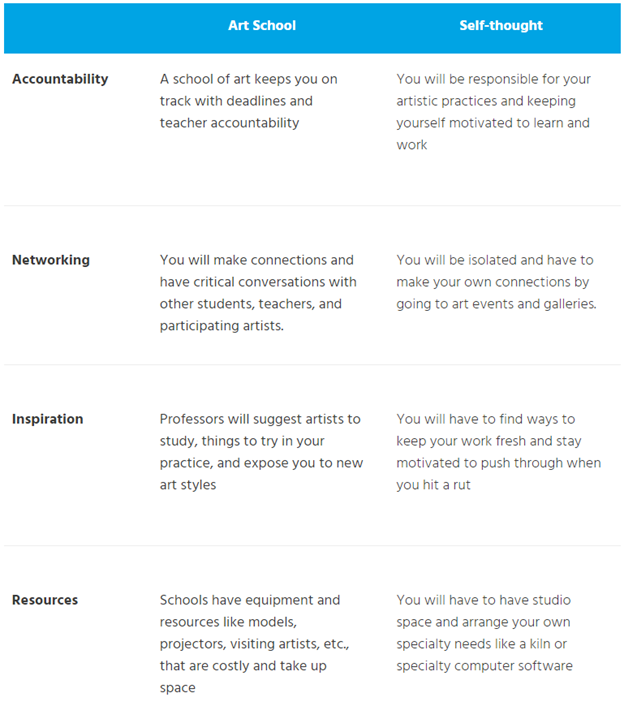
School vs Self Taught
Art Mentorships
Finding an art mentor can be a good idea whether you go to school or not.
What Does an Art Mentor Do?
An art mentor is like a sounding board for ideas for artworks, methods of artmaking, finding opportunities for selling your work, or other topics of critical engagement a professional artist will have experience with. Most often, they are paid, but sometimes, you can develop a relationship with a late-career artist who just wants to help younger artists.
Are Art Mentorships Worth It?
Art mentorships are worth it if you find the right person and have specific goals. You can learn things from an experienced artist that you won’t find in internet searches, and they will help you discover any blind spots you have around your art. Learning from someone else’s mistakes and experiences can save you time, money, and frustration.
Piero Lissoni: Environments

Edited by Stefano Casciani
With offices in Milan and New York, Lissoni & Partners has a 30-year history in developing international projects in the fields of architecture, landscape, interior, product, and graphic design, as well as acting as art director for a range of prestigious companies.
Led by Piero Lissoni, the practice combines a range of expertise with a tailored approach that sets it apart, establishing a stylistic code and a visual identity that are clearly recognizable. The works are inspired by a sense of rigor and simplicity and are characterized by a regard to detail, coherence, and elegance with particular attention to proportion and harmony.
The book, edited by Stefano Casciani, is the first far-reaching monographic study on Lissoni, richly illustrated with photographs, floor plans, and sketches. It is structured by theme and includes Lissoni’s most important projects for industrial and residential architecture, as well as commercial and public spaces, museums displays, boats, graphic design, and product design.
The Colour Bible by Laura Perryman

The Colour Bible is an essential and inspirational guide to colour in art and design. It’s a succinct book covering 100 significant colours and their pertinence and potential for use in the world around us.
Colour is multifaceted, without an understanding of the fundamentals of colour theory and understanding of how colour affects us – it can feel overwhelming. The book clearly highlights the foundations of colour, with tips on how to use colour for the better – to improve user experience and create improved palettes. There are cues of how to make successful but also intelligent palettes with each of the colour entries.
It’s chaptered by the spectrum red, yellow, orange, blue, greens, pales, darks and browns. Each chapter explores each colour area.
Every colour profile starts from the colour’s origin then tracks its evolution, historical use and where it lands today – the then and the now. Each entry finishes with a suggestion for the modern utility of the colour.
It’s visual – it was always going to be! Using examples of art or design to unpick individual colours, their histories, material origins – and demonstrates how they have context and relevance in today’s world – and showcases more advanced forms of colour, natural colour, and colour trends highlighting where they are heading.
Update: BOA added 6 new online courses in 3D Animation by LinkedIn Learning
Update: BOA added 6 new online courses in 3D Animation by LinkedIn Learning

BE OPEN: Gamification In EdTech: The Future of Innovative Learning. Pt.2
Implementing an intelligent and wise business approach to Edtech solutions for innovation, ease, and interactivity, gamification in eLearning is the next big innovation in the field.
Lessons With Games
When it comes to gamification, EdTech companies get a chance to encourage students with better concentration abilities and cognitive stamina. Moreover, gamification even helps to make things more fun and favorable for real-world situations. Above all, learning is all about inspiring the users with an innovative and engaging learning process. Gamification could help users by offering illustrations that trigger fascination for even the trickiest subjects.
Rewards With Gamified Learning
Another significant reason why the EdTech industry needs to invest in gamified learning is to exercise some control over the hours spent learning a module. With games and visuals, students can be introduced to a time slot during which they can interact with the application to avoid any unwanted stress and ensure value from the time spent. Also, students who show the most productivity in the given amount of learning time can be rewarded with level-up certifications. The most complicated and time-consuming subjects can be introduced to students with a smart approach to teaching, using gamification.
Relieving Stress and Improving Relationships
Last but not least, the gamification of EdTech helps students to explore new concepts and subjects in an innovative manner. The use of gamification techniques in eLearning applications could even aid the relationship between students and tutors while mitigating the whole hassle of standardizing apps. Students who are involved in the educational relationship through gamification could get more streamlined exposure to concepts. Also, gamified learning relieves the pressure that students might otherwise experience when taking tests in a physical environment. All in all, students and teachers who are tired of the extensive anxiety that they experience with the traditional approach to education could foster gamification to avoid the struggles associated with the standard academic process.
The Crux: Future Of Gamification in EdTech
In conclusion, the whole concept of gamification works by increasing the interactivity of the learning platforms. Gamification not only helps students to learn easily but also makes their learning journey a more enjoyable process. It helps students to be more proactive and relaxed during the learning cycle, while also giving them the chance to learn without any fear of errors or mistakes, especially when students get a chance to develop their skills with exposure to easy learning techniques. The EdTech industry is very likely to add more revenue and growth with the integration of gamification.
Moreover, the advanced learning medium could make it easier for teachers to offer their courses to a greater number of students. EdTech and gamification are concepts that are made to complement each other in the near future while allowing for more expansion in the industry. However, bringing these two concepts together equally demands a sophisticated and thoughtful approach to quality assurance. For educational institutions to offer a streamlined and dynamic learning environment to students, they must ensure a consistent sharing of information that would require the effective involvement of EdTech testing solutions.
It is equally important for the EdTech industry to understand that working alone on gamification could minimize the chances of exposure and the chances of moving ahead of the competition. Rather, the integration of other technologies like AI, VR, etc. can be pursued to get the growth that the EdTech industry is expecting in the upcoming years. In a nutshell, the path to success for gamification in EdTech is all about innovation, brought into the eLearning scenario through an intelligent and wise business approach. If you can make gamification in learning interactive and easy to pursue, for teachers as well as students, you are all set to stay ahead of the game.