




Update: BOA added 6 free video tutorials offered by FZDSCHOOL
Month: December 2023

Which eLearning trends are coming to the forefront year 2024. Pt.1?
Jump Into the Future of Learning!
As we look to the future of Learning and Development (L&D) in the year 2024 and beyond, it’s important to understand the trends that are shaping the industry. With advancements in technology and a shift towards remote work, L&D leaders and Chief Learning Officers need to stay ahead of the curve to ensure their teams remain competitive. Take a look into the top trends in Learning and Development, and what you can do to prepare for them.
1. Personalized Learning: Learning That Fits You
Imagine learning tailored exactly to your needs, pace, and preferences. That’s the beauty of personalized learning. In today’s tech-savvy world, AI and Machine Learning algorithms are turning this dream into reality for employees. L&D teams now craft individualized learning paths for each team member. It’s like having a personal tutor, guiding you through your learning journey. Whether it’s a new skill or brushing up on existing knowledge, personalized learning ensures higher engagement and retention rates. After all, when the content matches your needs, learning becomes a breeze!
- Key points
- Customized learning paths for each employee
- AI and Machine Learning create tailored learning experiences
- Higher engagement and retention rates
2. Gamification: Learning Made Fun
Who said learning can’t be fun? Enter gamification! By transforming learning into a game, employees are not only motivated but eager to dive into new knowledge. Whether it’s through simulations, quizzes, or interactive videos, gamification adds that element of fun and challenge to learning. Think of it as unlocking achievements or reaching new levels in a game. It taps into our competitive spirit and desire for accomplishment. With the popularity of gaming, it’s no surprise that turning learning into a game is becoming a go-to strategy in L&D.
- Key points
- Motivates employees through game-like learning experiences
- Increases engagement and motivation to learn
- Different formats like quizzes, simulations, and interactive videos
3. Microlearning: Bite-Sized Knowledge Nuggets
In a world where time is a precious commodity, microlearning swoops in as the hero. This trend focuses on delivering information in bite-sized portions. No more hour-long lectures! Instead, think of short videos, infographics, or quick podcasts, serving the right information at the right time. It’s about efficiency—employees absorb information swiftly without overwhelming themselves. Microlearning is perfect for our fast-paced lives, offering digestible nuggets of knowledge that can be consumed on the go.
- Key points
- Provides quick, bite-sized learning modules
- Formats include short videos, infographics, and podcasts
- Ideal for busy schedules and quick information absorption
4. Virtual Reality: Immersive Learning Worlds
Step into a whole new world with Virtual Reality (VR). VR headsets whisk employees away to immersive training environments. Whether it’s safety simulations or customer service scenarios, VR makes learning incredibly realistic and engaging. Imagine practicing customer interactions or handling complex machinery without any real-world risks. As VR technology advances, the potential for innovative L&D experiences continues to expand, making learning truly immersive and memorable.
- Key points
- Immersive training through VR headsets
- Realistic simulations for various training scenarios
- Advancing technology opens doors for new learning experiences
5. Learning Analytics: Harnessing Data or Improvement
Learning analytics isn’t just about numbers; it’s about using data to optimize learning outcomes. By analyzing metrics like engagement rates and quiz scores, L&D teams gain insights into what works and what doesn’t. This data-driven approach helps fine-tune training programs for maximum effectiveness. It’s like having a roadmap and knowing which paths lead to successful learning outcomes. Learning analytics is a game changer, guiding L&D strategies toward success.
- Key points
- Analyzes data to improve learning outcomes
- Tracks engagement rates, completion rates, and more
- Data-driven decisions for optimizing training programs
Originally published at inkling.com.
Pentagram: Living by Design
 Author: Adrian Shaughnessy
Five years in the making, Pentagram: Living by Design (two volumes) is the definitive statement on fifty years of Pentagram, and an in-depth survey of the group from its beginnings in 1970s London to its current status as one of the powerhouses of international design.
Book one, The Biography, offers a comprehensive analysis of the group, its partners, its achievements, its multidisciplinary approach and its unique business model. This is accompanied by a plethora of images (some never published), a visual essay of Pentagram’s work across four main sectors, a selection of partners’ writings, a Pentagram family tree, and much more.
Book two, The Directory, has profiles of fifty partners, past and present, accompanied by extensive coverage of their work. It’s a stellar roll call: from the five famous founders to some of the most celebrated names in contemporary design. It also includes a list of everyone who worked in the firm’s various offices.
Both books are designed by Tony Brook and the Spin design team.
How Design Makes Us Think: And Feel and Do Things by Sean Adams
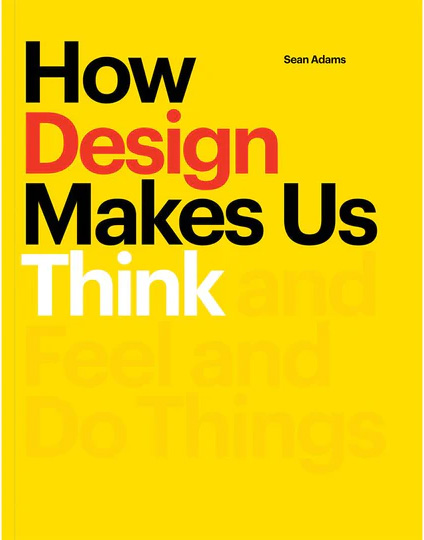
Design is everywhere. It’s visceral. It’s intellectual. It’s emotional. While we often discuss the aesthetics of design, we don’t always dig deeper into the ways design can overtly, or covertly, influence how we feel and act.
In How Design Makes Us Think, AIGA award-winning graphic designer Sean Adams walks us through the power of design to attract attention and convey meaning. Through hundreds of examples across design principles, from graphic design to industrial design to architecture, Adams illustrates how design can inspire, provoke, amuse, anger, or reassure us, or subtly or consciously influence our thoughts and behavior.
The book also delves into the sociological, psychological, and historical reasons for our responses to design, offering practitioners and clients alike a new appreciation of their responsibility to create design with the best intentions. How Design Makes Us Think is an essential read for designers, educators, advertisers, psychology enthusiasts, marketing professionals, and anyone who wants to understand how the design around us makes us think, feel, and do things.
Find out more about How Design Makes Us Think: And Feel and Do Things by Sean Adams →
Bringing Learning to Life: The Power of Animation in eLearning
Using animation in eLearning can greatly improve user engagement and comprehension. Effective animation should be clear, consistent, and functional, enhancing the learning experience.
The Role of Animation in eLearning
In the digital age, eLearning has become an essential tool for educators and learners alike. With the rise of online courses and virtual training programs, Instructional Designers are constantly seeking innovative ways to engage learners and enhance the educational experience. One such method that has proven to be highly effective is the use of animation. The role of animation in eLearning is not only to capture attention but also to simplify complex concepts, making learning both enjoyable and memorable.
Animation has the unique ability to convey messages and teach lessons in a dynamic and visually appealing way. By incorporating animated elements into eLearning modules, educators can create a narrative that resonates with learners of all ages. Animations can range from simple motion graphics that highlight key points to full-fledged animated stories that provide context and depth to the learning material.
Adapting To Trends
Staying current with animation trends is vital for eLearning. Micro-animations are now widely used to guide learners subtly and reinforce their interactions. Kinetic typography brings energy to text, making key points stand out. Parallax scrolling adds depth to storytelling, while animated infographics turn complex data into engaging narratives. Additionally, responsive animation ensures that eLearning content is accessible and performs well across all devices.
Benefits Of Animation In eLearning
Improved Understanding
Complex subjects can be broken down into digestible pieces with the help of animation. By visualizing abstract concepts, learners can grasp difficult topics more easily.
Increased Retention
The combination of audio and visual elements in animation aids in better retention of information. Animated stories and scenarios can be particularly effective for long-term memory recall.
Emotional Connection
Characters and narratives in animations can evoke emotions, making the learning experience more personal and impactful. This emotional investment can lead to a deeper understanding and appreciation of the content.
Accessibility
Animation can make learning more inclusive by providing visual cues that support various learning styles, especially for visual and auditory learners.
Visual Hierarchy and Guidance
Animation can be used to establish a visual hierarchy on the screen, directing learners’ attention to the most important elements. Animated cues or transitions can guide users through the learning process, ensuring a smooth and intuitive user flow.
Feedback And Motivation
Interactive animations can provide immediate feedback on learners’ actions, which is essential for reinforcing learning and motivation. For example, a character might applaud or give a thumbs-up in response to a correctly answered question.
Emotional Design
Animations have the power to evoke emotions and create a more personable User Experience. By incorporating characters or storytelling elements, animations can make the learning experience more relatable and enjoyable.
How To Effectively Use the Role of Animation In eLearning
- Integrate with interactivity
Combine animations with interactive elements such as quizzes or drag-and-drop activities to create an engaging learning environment. - Optimize for different devices
Ensure that animations are optimized for performance across various devices, including desktops, tablets, and smartphones. - Design for interactivity
Integrate animations with interactive elements to encourage active learning and user participation. This can include clickable animations that reveal additional information or branching scenarios that change based on user decisions. - Ensure consistency
Maintain a consistent style and behavior for animations throughout the eLearning course. Consistency helps users build a mental model of how interactions work, leading to a more predictable and comfortable learning experience. - Test with real users
Conduct user testing to gather feedback on the animations’ effectiveness and appeal. Observing real users interacting with the animations can provide insights into how they contribute to the overall User Experience and where improvements may be needed. - Adapt for accessibility
Design animations with accessibility in mind, providing alternatives for users who may have issues that affect their ability to perceive motion. This includes options to pause, stop, or hide animations, as well as providing text descriptions where necessary.
Conclusion
Animation is a versatile and powerful tool in the realm of eLearning. When used thoughtfully, the role of animation in eLearning can be to transform the educational experience by making learning more engaging, understandable, and enjoyable. As technology continues to advance, the possibilities for incorporating animation into eLearning will only expand, offering new and exciting opportunities to enrich the learning journey. By embracing the art of animation, Instructional Designers and educators can create eLearning content that not only informs but also inspires.
Update: BOA added 6 new online courses in Web Design, Graphic Design and Software Design offered by EduCBA, eTrain and LinkedIn Learning
Update: BOA added 6 new online courses in Web Design, Graphic Design and Software Design offered by EduCBA, eTrain and LinkedIn Learning