




The New Design Portfolio: Why Process Will Matter More Than Final Output (Pt.2)

The New Design Portfolio: Why Process Will Matter More Than Final Output (Pt.2)

PART 2. From Process to Trust

The Rise of the AI-Use Log

One practical change in future portfolios may be the introduction of an AI-use log: a short explanation of how AI was used in a project.

For example: AI was used for early moodboard exploration; to test alternative compositions; to generate visual references later manually developed; to summarise user interviews, followed by human review; or to create options that were rejected because they did not fit the ethical or cultural direction of the project.

This kind of documentation helps answer an increasingly important question: what exactly is the student’s contribution?

It also teaches transparency. As AI becomes more present in creative industries, designers will need to explain how images, prototypes and concepts were produced. Content Credentials and provenance technologies are already emerging as ways to provide information about who created a piece of content, when it was produced and which tools or editing processes were involved.

A transparent portfolio says: this is how I worked, this is what the tool did, this is what I did, and this is why the final decision was mine.

Source:
https://contentauthenticity.org/how-it-works

What Admissions Tutors and Employers Need to See

Different schools, studios and employers will evaluate portfolios in different ways. Yet across disciplines, evaluators want to understand potential.

University of the Arts London describes a portfolio as a collection of work that shows how creativity has developed over time, including research, planning, experimentation and even mistakes made along the way. The University for the Creative Arts similarly advises students to document their process, tell a story from research to outcomes, and show unfinished work or failed experiments when they reveal learning.

These points are especially important in an AI-shaped environment. A portfolio that only displays final images may show taste, but not growth; style, but not resilience. A process-led portfolio can reveal curiosity, independence, adaptability, critical thinking, ethical awareness, collaboration and capacity to learn.

Sources:
https://www.arts.ac.uk/study-at-ual/apply/portfolio-advice
https://www.uca.ac.uk/blogs/creating-a-product-design-portfolio-for-university/

The New Portfolio Structure

If the portfolio is becoming more process-led, students can organise each project as a short story rather than a sequence of final images.

A useful structure might include the question, the context, the research, the experiments, the role of AI or digital tools, the decision points, the outcome and the reflection: what was explored, why it mattered, what was tested, what changed, what was made and what remains unresolved.

This structure does not make portfolios less visual. It gives images more meaning.

Failure, Position and Systems Thinking

Many students worry that showing failed experiments will make their work look less professional. In reality, carefully selected failures can make a portfolio stronger if the student explains what did not work, what was learned, and how that learning shaped the next decision.

Portfolios have also often been used to show personal style. Style still matters, but in the AI era it may become easier to imitate. What may matter more is position: what the designer cares about, what values shape their decisions and what futures they want to help create.

The strongest portfolios may also show an ability to think beyond individual objects. Many of today’s challenges are systemic: climate change, inequality, ageing populations, urban density, waste, mobility, digital trust and public health. Design Council’s Systemic Design Framework describes systemic design as a way of acknowledging complexity and interconnectedness.

For students, this means portfolios can show not only the object or image, but the system around it: stakeholder maps, lifecycle thinking, service journeys, material flows, community feedback or unintended consequences.

Source:
https://www.designcouncil.org.uk/resources/systemic-design-framework/

Ethics, Authorship and Responsibility

As AI becomes part of design education, portfolios will also need to address ethical responsibility.

Students should be prepared to explain where images came from, how tools were used, whether data or references were appropriate, and how they considered bias, accessibility, inclusion and environmental impact.

UNESCO’s guidance on generative AI in education and research highlights the need for human-centred, safe, equitable and meaningful use of these technologies. For design students, using AI well is not only a question of technical skill. It is a question of responsibility.

A future portfolio may include short ethical reflections: Were the references culturally sensitive? Were users or communities represented fairly? Did the AI output contain stereotypes? Were accessibility needs considered? Could the design have unintended negative consequences? Was the student transparent about the process?

In the AI era, authorship is no longer just about who made the final image. It is about who made the decisions.

Source:
https://www.unesco.org/en/articles/guidance-generative-ai-education-and-research

Key Takeaways for Design Students

  • Do not treat your portfolio as a gallery of final images only.
    · Show the journey from research to outcome.
    · Document experiments, prototypes, feedback and failures.
    · Explain where and why AI tools were used.
    · Make your own contribution clear.
    · Use short annotations to reveal decision-making.
    · Show how your ideas changed over time.
    · Include ethical and contextual reflection where relevant.
    · Demonstrate curiosity, adaptability and critical thinking.
    · Remember that process is not separate from design. It is design.

Looking Ahead

Generative AI is changing the way creative work is produced, but it is also changing the way creative work must be explained.

For design students, the challenge is no longer simply to produce impressive outcomes. It is to show the intelligence behind those outcomes.

The strongest portfolios will reveal not only skill, but judgment. Not only style, but position. Not only what was made, but why it matters.

In a world where images can be generated quickly, the designer’s process becomes a source of trust. And the portfolio becomes something more than a presentation of work. It becomes a portrait of a mind at work.

Art for All. Art History

Art for All. Art History

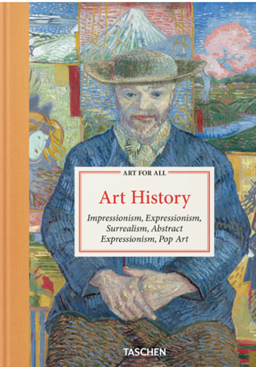
A comprehensive volume covering five seminal genres that shaped art, from the late 19th century and well into the 20th: Impressionism, Expressionism, Surrealism, Abstract Expressionism and Pop Art. Each approach was distinct in aesthetic and philosophy, but all had immediate impact and enduring influence. Many great names were indelibly associated with one, some explored several during their careers.

Impressionism, led by Monet and Renoir, focused on light and color, capturing fleeting moments and challenging academic art’s rigidity. Expressionism was driven by artists like Edvard Munch and Wassily Kandinsky to convey raw emotion, distorting reality to reflect the angst of human experience. Surrealists, like Salvador Dalí and René Magritte, explored the subconscious, dreams, and the irrational, blending reality with fantasy across art, literature, and film. With Jackson Pollock and Mark Rothko leading the charge, Abstract Expressionism emphasized spontaneity and emotion through bold, gestural brushstrokes, and established New York as the post-war art world’s new Mecca. Finally, artists like Roy Lichtenstein and Andy Warhol gained fame and dominated the zeitgeist by synthesizing advertising, pop culture, and high art into Pop Art.

Find out more about Art for All. Art History →

The New Design Portfolio: Why Process Will Matter More Than Final Output (Pt.1)

The New Design Portfolio: Why Process Will Matter More Than Final Output (Pt.1)

PART 1. From Finished Work to Visible Thinking

As generative AI makes polished images easier to produce, design students need to rethink how they present their work. The strongest portfolios of the future will not simply showcase beautiful outcomes. They will reveal how designers think, research, question, experiment, collaborate and make responsible creative decisions.

For generations, portfolios have helped students enter education, employment and professional life. They have often been judged by final outcomes: the refined image, elegant product, strong campaign, impressive rendering or memorable visual identity.

But generative AI is changing this logic. Today, AI tools can produce images, layouts, product concepts, moodboards, type treatments, 3D directions and storyboards with extraordinary speed. This raises a difficult question: if polished outputs become easier to generate, what will make a designer’s portfolio stand out?

The answer is increasingly clear. The future design portfolio will need to show more than what a student made. It will need to show how they thought.

From Portfolio as Gallery to Portfolio as Evidence

A portfolio has often been treated as a gallery: a carefully arranged selection of finished work. That model is not disappearing. Final work still matters. Craft, clarity, material intelligence and visual confidence remain important parts of design.

But the gallery model is no longer enough. In the age of AI, a finished image can hide too much. It may not reveal whether the student understood the problem, developed the idea independently, used AI responsibly, tested alternatives, considered users or made thoughtful decisions along the way.

A stronger portfolio acts less like a gallery and more like evidence. It shows the journey behind the outcome: the brief, research, constraints, iterations, failures, prototypes and reasoning that shaped the final result.

A good portfolio should answer not only “What did you make?” but also: what problem were you trying to solve, why did it matter, what changed during the process, and what did you learn?

In this sense, the portfolio becomes a record of design intelligence.

BE OPEN Insight

When images become easier to generate, thinking becomes harder to fake.

The future portfolio will not be defined only by the beauty of its final outcomes. It will be defined by the clarity of the process behind them. For young designers, the ability to explain how an idea developed, why decisions were made and what values guided the work may become one of the most important signs of creative maturity.

Why Final Output Is Losing Its Monopoly

For a long time, the final output carried most of the communicative weight in a portfolio. A strong poster, object, interface or installation could suggest that the student had the skills required to produce it.

That assumption is becoming weaker. Generative tools can produce a high level of visual finish even when the underlying concept is shallow. A student may create a striking image without a meaningful brief, original research, user understanding or contextual testing.

The viewer needs to know what the student contributed. Did they define the direction? Curate the references? Write the prompts? Combine AI-generated material with drawing, modelling, photography or physical experimentation? Reject weaker options?

The value of the portfolio shifts from surface to authorship. AI may help produce options. The designer must show judgment.

Process as a Creative Skill

Process is sometimes misunderstood as something messy that happens before the “real” work begins. In fact, process is where much of design value is created.

It is where students learn to observe, question and reframe; discover that the first idea is rarely the best one; test materials, encounter constraints, receive criticism and change direction.

Showing process does not mean including every sketch, screenshot or unfinished experiment. A portfolio still needs editing. But it should reveal enough of the journey to make the student’s thinking visible: research notes, references, user observations, sketchbook pages, material tests, prototypes, failed experiments, prompt variations, AI outputs, feedback and short reflections on what changed and why.

The goal is not to show chaos. The goal is to show how an idea became stronger.

Case Study: Adobe and Parsons Explore Creative AI in Education

A collaboration between Adobe and Parsons School of Design shows how design education is beginning to rethink creative practice in the age of AI.

Students worked with tools such as Adobe Firefly, Photoshop, Lightroom and Premiere, and explored Content Credentials through the Content Authenticity Initiative. AI was not treated simply as a shortcut for final images. It was used for ideation, exploration, visual development and reflection.

For portfolio thinking, the lesson is significant. If students use AI, they should explain how it helped generate directions, how outputs were selected or rejected, and where creative control remained human. This transparency can make AI-assisted work more credible, not less.

Source:
https://adobe.design/ideas/creativity-in-the-age-of-ai

Vanity Fair 100 Years: From the Jazz Age to Our Age by Graydon Carter

Vanity Fair 100 Years: From the Jazz Age to Our Age by Graydon Carter

Since its founding in 1913, Vanity Fair has chronicled the evolution of the modern era, spanning the Jazz Age, the Depression, the Reagan era’s economic boom, and the visually saturated Information Age. The magazine has done so through its distinctive blend of wit, imaginative storytelling, and high-caliber literary content, complemented by striking visuals created by some of the most acclaimed photographers, artists, and illustrators of their time.

Edited by Graydon Carter, the lavishly produced book offers a decade-by-decade exploration of the world as seen through the lens of Vanity Fair. It highlights the magazine’s unique editor, Frank Crowninshield, and its groundbreaking launch during the Jazz Age. The book also delves into the magazine’s controversial resurgence in 1983 and chronicles the storied history of the iconic Vanity Fair Oscar Party.

Find out more about Vanity Fair 100 Years: From the Jazz Age to Our Age by Graydon Carter →