BE OPEN: the Future of Education as seen by UNESCO’s Special Commission and nine ideas for post-COVID action

BE OPEN: the Future of Education as seen by UNESCO’s Special Commission and nine ideas for post-COVID action

The global health pandemic has shined a harsh light on the vulnerabilities and challenges humanity faces. It has provided a clear picture of existing inequalities—and a clearer picture of what steps forward we need to take, chief among them addressing the education of more than 1.5 billion students whose learning has been hampered due to school closures.

The UNESCO International Commission on the Futures of Education presented nine key ideas for navigating through the COVID-19 crisis and its aftermath, contending that we cannot forget core principles and known strengths as we face unprecedented disruption to economies, societies and—our particular focus here— education systems.

It is evident that we cannot return to the world as it was before. One of the strongest messages in the report is that our common humanity necessitates global solidarity. We cannot accept the levels of inequality that have been permitted to emerge on our shared planet.  It is particularly important that the world supports developing countries with investment in 21st century education infrastructures; this will require the mobilization of resources and support from developed countries, in particular with debt cancellation, restructuring, and new financing.

The magnitude of this challenge is clearly evident with regard to the digital divide in Africa. For example, only 11% of learners in sub-Saharan Africa have a household computer and only 18% have household internet, as compared to the 50% of learners globally who have computers in the home and the 57% who have access to internet. Already we see that the disruptions brought on by the pandemic are exacerbating inequalities both within and across countries. We urgently need investment and structural change so that short-term setbacks do not grow into larger, long-lasting problems.

There is a serious risk that COVID-19 will wipe out several decades of progress—most notably the progress that has been made in addressing poverty and gender equality. While the pandemic demonstrates that we belong to one interconnected humanity, social and economic arrangements mean that the impacts of the virus are disparate and unjust. Gender discrimination means that girls’ educational attainments are likely to suffer greatly, with a risk of many not returning to school post-COVID-19. This is not something we should accept; we must do everything in our power to prevent it. COVID-19 has the potential to radically reshape our world, but we must not passively sit back and observe what plays out. Now is the time for public deliberation and democratic accountability. Now is the time for intelligent collective action.

Decisions made today in the context of COVID-19 will have long-term consequences for the futures of education.  Policy-makers, educators and communities must make highstakes choices today—these decisions should be guided by shared principles and visions of desirable collective futures.   COVID-19 has revealed vulnerabilities; it has also surfaced extraordinary human resourcefulness and potential.  This is a time for pragmatism and quick action, but it is also a moment when more than ever we cannot abandon scientific evidence. Nor can we operate without principles. Choices must be based on a humanistic vision of education and development and human rights frameworks.

The 2030 Agenda for Sustainable Development provides many of the necessary signposts and guidelines. The International Commission on the Futures of Education—established by UNESCO in 2019 and composed of thought leaders from the worlds of academia, science, government, business and education—presents nine ideas for concrete actions today that will advance education tomorrow.

  1. Commit to strengthen education as a common good. Education is a bulwark against inequalities. In education as in health, we are safe when everybody is safe; we flourish when everybody flourishes.
  2. Expand the definition of the right to education so that it addresses the importance of connectivity and access to knowledge and information.  The Commission calls for a global public discussion—that includes, among others, learners of all ages—on ways the right to education needs to be expanded.
  3. Value the teaching profession and teacher collaboration. There has been remarkable innovation in the responses of educators to the COVID-19 crisis, with those systems most engaged with families and communities showing the most resilience.  We must encourage conditions that give frontline educators autonomy and flexibility to act collaboratively.
  4. Promote student, youth and children’s participation and rights. Intergenerational justice and democratic principles should compel us to prioritize the participation of students and young people broadly in the co-construction of desirable change.
  5. Protect the social spaces provided by schools as we transform education.  The school as a physical space is indispensable.  Traditional classroom organization must give way to a variety of ways of ‘doing school’ but the school as a separate space-time of collective living, specific and different from other spaces of learning must be preserved.
  6. Make free and open source technologies available to teachers and students. Open educational resources and open access digital tools must be supported.  Education cannot thrive with ready-made content built outside of the pedagogical space and outside of human relationships between teachers and students.  Nor can education be dependent on digital platforms controlled by private companies.
  7. Ensure scientific literacy within the curriculum. This is the right time for deep reflection on curriculum, particularly as we struggle against the denial of scientific knowledge and actively fight misinformation.
  8. Protect domestic and international financing of public education. The pandemic has the power to undermine several decades of advances.  National governments, international organizations, and all education and development partners must recognize the need to strengthen public health and social services but simultaneously mobilize around the protection of public education and its financing. 9. Advance global solidarity to end current levels of inequality.

COVID-19 has shown us the extent to which our societies exploit power imbalances and our global system exploits inequalities.  The Commission calls for renewed commitments to international cooperation and multilateralism, together with a revitalized global solidarity that has empathy and an appreciation of our common humanity at its core. COVID-19 presents us with a real challenge and a real responsibility. These ideas invite debate, engagement and action by governments, international organizations, civil society, educational professionals, as well as learners and stakeholders at all levels.

BE OPEN: Ingrained Assumptions that Challenge Higher Education

BE OPEN: Ingrained Assumptions that Challenge Higher Education

How best to adapt to today’s post-Golden Age realities, according to professor of history at the University of Texas at Austin Steven Mintz.

Seven years ago, Clay Shirky, who is now NYU’s vice provost of educational technologies, wrote a provocative and prescient blog post, which argued that higher education’s biggest challenges — especially its increasing reliance on non-tenure-track instructors — arose from the attempt “to preserve a set of practices that have outlived the economics that made them possible.”

Entitled “The End of Higher Education’s Golden Age,” Shirky wrote that colleges and universities clung to assumptions and expectations that arose during the period of rapid growth that stretched from the end of World War II to the early 1970s, when “the number of undergraduates increased five-fold, and graduate students nine-fold” and when states more than doubled their higher education appropriations and federal research grants quadrupled.

Several “Golden Age” assumptions, now sadly outdated, persist:

That demand for higher education is virtually inexhaustible, and, as a result, institutions can take enrollment growth for granted.

That full-time, first-time-in-college residential students represent an ideal that colleges and universities should prioritize in admissions.

That most students want and need an educational experience that is basically the same as that offered three-quarters of a century ago.

That rising costs can be addressed through tinkering, including modest increases in tuition and fees, government aid, and a limited reliance on adjunct instructors.

That there was no inherent conflict between tenured faculty’s teaching and research responsibilities; that teaching loads and mentoring responsibilities can fall and research expectations can rise without posing any particular problems for their institutions.

Each of these assumptions has proven profoundly misleading.

Enrollment declines have persisted for a decade. This decline poses particular challenges for small and regional institutions in the Northeast and Midwest.

Nontraditional students are as important to institutional and societal success as traditional students. Students who commute, work full-time, caregive or who have transferred represent a majority of those pursuing degrees and have different needs than those who traditional students who defined higher education’s Golden Age.

Student needs have shifted and intensified. Institutions have been forced to devote significantly more resources to financial aid and the support services that nontraditional and post-traditional students needed to succeed.

Two- and four-year institutions have found it difficult to effectively serve the growth sectors. Traditional degree and training programs have had very mixed success in serving students from low-income backgrounds, community college transfer students and working adults’ needs for retooling, upskilling and skills training.

Higher education’s cost challenges cannot be met through tinkering. To cut costs, institutions have relied increasingly on non-tenure-track faculty, and underresourced institutions have eliminated or consolidated programs. To increase revenue, colleges and universities have had to become much more entrepreneurial, admitting more international students (and, at public institutions, more out-of-state students), establishing online professional master’s programs, and treating ancillaries as revenue generators.

A caste system has emerged, in which the interests of tenured faculty and nontenured instructors and professional staff have diverged. To reduce the teaching loads of tenured faculty and free them of responsibility for advising and teaching introductory, language and composition courses, while keeping instructional costs stable, institutions increasingly relied upon lower-paid non-tenure-track instructors: graduate students, adjuncts, lecturers and postdocs and an expanding number of nonteaching professionals (including professional advisers, disability specialists, instructional designers and educational technologists, psychological counselors, and staff to run teaching, math, science and writing centers).

What made Shirky’s blog post especially controversial was his claim that higher education’s major beneficiaries are tenured faculty and senior administrators, whose salaries rose even during the Great Recession and whose perks now come largely at the expense of adjunct faculty and other contingent staff members.

The argument that tenure screens out more than it protects by creating a sharp divide between insiders and those outside the charmed circle is now increasingly voiced on the left as well as the right.

As a friend put in response to a recent forum on the future of tenure, “It’s like castles in the late Middle Ages — cannons just mean you build thicker and thicker walls to protect fewer and fewer people.”

As Shirky’s blog entry made devastatingly clear, addressing salary inequities between the tenured and nontenured teaching staff cannot be met simply by trimming administrative bloat or eliminating waste.

At his institution, cutting administrative salaries by 25 percent would save about $5 million (in 2014 dollars), but raising adjunct salaries would cost $250 million, about 17 percent of NYU’s academic budget at the time.

Reducing inequalities within individual institutions and across higher education more generally will require far-reaching shifts in mind-set and priorities. Otherwise, we are just perpetuating “an arrangement that works well for elites — tenured professors, rich students, endowed institutions — but increasingly badly for everyone else.”

So how, then, can higher education adapt to students’ changing needs and new demographic, economic and cultural realities?

Solutions aren’t easy. Unionization can, to a certain extent, address some inequities in salaries and working conditions but can also result in unanticipated outcomes. At CUNY, for example, a contract that significantly increased the pay of part-time adjuncts had the effect of reducing their numbers while increasing reliance upon untenured lecturers with full-time appointments, who were cheaper on a per-class basis.

Other pressures are brewing. We’re witnessing:

A push by state legislatures to cut college costs and expedite time to degree by encouraging completion of gen ed classes during high school as a way to cut college costs, making the community college transfer process more seamless and requiring four-year schools to enroll more transfer students or allow two-year institutions to award applied bachelor’s degrees.

Growing demands that deep-pocketed private institutions increase their enrollment, either modestly or radically.

The emergence of cheaper, faster paths to employment, including short-term, noncredit and corporate-sponsored certificate training programs.

What should colleges and universities do to adjust to our post-Golden Age realities? Some strategies are obvious:

Hope that the Biden administration will provide the funding necessary to sustain and strengthen the current model through a combination of debt relief, expanded federal financial support and encouragement of the enrollment of international students.

Make greater use of personalized, adaptive courseware, autograding and peer evaluation to allow faculty to scale gateway courses and of degree maps, degree progress monitoring tools and data analytics to track student progress, prompt timely interventions and supplement person-to-person advising.

Increase online course sharing to ensure access to specialized or difficult-to-staff programs.

Expand offerings of career-aligned certificates and certifications, which can be embedded into career paths or pursued separately.

There is, however, an alternative that I think is worthy of attention: change the game.

Perhaps you remember the conclusion to the 1983 American Cold War science fiction techno-thriller WarGames: “The only way to win is not to play.”

Sometimes, the way to win is to change the game.

As a thought experiment, let’s think of how we might change the game to better serve students with very different needs, levels of preparation, circumstances and aspirations. We might:

Expand enrollment at the more selective institutions. Not by expanding facilities, but by rethinking the academic calendar, having juniors and seniors live off campus, and adopting a HyFlex model for the delivery of the most popular classes — while hiring more faculty to maintain quality.

Create an educational journey less centered on traditional lectures, courses and seminars. There are alternate ways to deliver those classes’ content, for example, by using courseware supplemented by online lectures and various forms of support, or through novel kinds of blended experiences that involve less time in formal classrooms.

Make experiential and project-based learning much bigger parts of the undergraduate experience. Downplaying traditional classes might free students to devote more time to other educationally impactful experiences: taking part in internships (some of which should be on campus in various institutional offices); working on supervised research projects, either alone or in groups; participating in field-based and service learning activities; or contributing as team members to a faculty project.

Ensure that every student is part of a learning community, not just in their first semester or first year, but at a number of points in their education. These communities might offer a space where students can undertake projects, make presentations based on their findings or creative endeavors, and critically reflect on their learning.

Fund public institutions in ways that take account of their students’ needs. Let’s alter the current model in which there is an inverse relationship between students’ learning needs and the level of public support.

The biggest challenge facing higher education is our willingness to rethink entrenched practices and legacy assumptions.

When I arrived at Oberlin College in the fall of 1970, the new president made a modest proposal: to eliminate almost all requirements and make students responsible for designing their educational journey. His goal: to produce more self-directed graduates.

Times have changed, and higher education needs to adapt to new realities: to the diversity of our students and to the financial and equity challenges faced by most colleges and universities. The solution, I am convinced, lies in our willingness to think outside the boxes that narrow our sense of possibilities.

BE OPEN: Zoom in Higher Education

BE OPEN: Zoom in Higher Education


With the COVID-19 speeding up the shift of higher education online, it might seem that the golden era of online education has finally come. However, while some educators sing praise of Zoom lectures and are going to keep this tool in their teaching kit even when the crisis is over, others ring the alarm creating awareness of Zoom fatigue. So, what about Zoom? Is it a blessing or a curse?

The major shift higher education is going through can be called seismic changes only partially. It is true that the situation was greatly influenced by the novel coronavirus pandemic. But it is also cannot be denied that the recent move online is a direct result of a long-delayed response to demographic and economic shifts and of the technological change, which has been underway since around 2010, when universities and private entrepreneurs first began to experiment with Massive Open Online Courses, or MOOCs.

Back then, these early MOOCs could hardly compete with the mainstream providers of traditional, campus-based higher education and were mainly viewed upon as a complementary tool for those who cannot afford going to college for financial or social reasons. Even today, the many discussions around the topic demonstrate that online learning, which has morphed from the earliest MOOCs and has been forced upon the most conservative universities and colleges by the pandemic, is still in the middle of its own evolution.

Most Zoom sessions offered to the students in 2020 looked more like a hasty adaptation in the times of a crisis. Everyone and his brother has discussed the limitations of using Zoom, which was not originally developed as a pedagogical tool.

Not all classroom formats translate easily onto Zoom. It works well for small-scale seminars and critiques, which do not lose intimacy and close contact of campus-based classes even online. Bringing in guest speakers works remarkably well, allowing faculty to introduce a wide range of voices into their classroom conversations. On the screen, everyone can see and hear and participate.

However, videoconferencing could hardly be the answer when it comes to classes requiring practical instructions and other hands-on teaching methods, which are often the key for fine arts and design education.

Zoom lectures are not so unambivalent either. They might work, if the instructor is compelling. Still, it is no secret that the fastest way to lose the attention of students on Zoom is to talk at them. It is even more complicated for learners to follow the lecturer when they find themselves gazing into a sea of black boxes, while all kinds of distractions are close at hand in their “home office.” “Students’ faces slip from one screen to the next as new people join in. They disappear into a tiny side panel once anything is shared. Unmuting becomes a weary standard of the class period (“can you hear me now?”) And everything in everyone’s background–the dogs, the posters, the siblings, the furniture–melds into a visual cacophony. On Zoom, the peripheral truly takes over,” Debora Spar, senior associate dean of Harvard Business School Online, explains.

Class conversations on Zoom also seem to be very different from those held in a classroom of brick and mortar. Inevitably, a few students will dominate the conversation leaving quitter ones and those experiencing problems with their internet connection excluded and shut out. This requires teachers to be very directive on Zoom, asking some students to speak and diplomatically cutting off others to bring taciturn ones into the discussion.

Participating in a synchronous online class taxes powers of both the student and the instructor. Though the reasons why online meeting tools are more exhausting are not fully understood, this effect likely has something to do with how our brains process screen as compared to physical presence.

When asked to describe their online learning routine, students talk about spending most of their day in front of the screen. With classes and homework running entirely online, some claim they click their camera on as soon as they roll out of bed, others complain that screen time feels like a 24/7 commitment. Even when they are not actively on a Zoom call, Canvas discussion boards and Google Docs absorb all their studying time. This pattern induces what many call “Zoom fatigue” — exhaustion from blue light and remote interactions, which is strongly related to our brain’s inability to differentiate Zoom meetings from everything else we do onscreen, drawing down the same reserve of focus. This also brings to the lack of any physical mobility between classes.

Synchronous Zoom sessions is even more exhausting for international students, who are faced with a time difference from their classmates and professions. E.g. for learners in China studying in US universities and colleges classes could start at 11 pm and run till 2:30 am.

Besides, growing popularity of Zoom sessions reveal socio-economic differences that are harder to notice on physical campuses. This teaching method places low-income students at a disadvantage. The underprivileged group cannot afford the cost of an Internet upgrade and therefore can experience connectivity issues, which might cause video or audio interference and impair their ability to participate in discussions on Zoom.

Dr. Joshua Kim, Director of Online Programs and Strategy at the Dartmouth Center for the Advancement of Learning (DCAL), is convinced that when it comes to Zoom and teaching, less is more. He suggests following a three-to-one strategy, holding one hour of Zoom for every three hours of class and making that time more conversation-based. Instead of taking three Zoom meeting a week, he recommends using those time blocks to hold three separate Zoom sessions and letting students signing up for just one discussion per week – to reduce the overall time students spend on Zoom.

Lucy Biederman, assistant professor of creative writing at Heidelberg University, believes that the role of Zoom in online college teaching is overestimated. In her opinion, when faced with closing campus in March 2020, most of the instructors turned to Zoom as an alternative to teaching in a physical classroom and remain dependent on this software without taking a broader picture. Biederman points out that videoconferencing software wasn’t an essential part of higher education before the pandemic, and warns against using this technology solely for technology’s sake.

Derek Bruff, director of the Vanderbilt University Center for Teaching, also believes that learning objectives should guide how college instructors use technology, not the other way around. He has coined the term “intentional tech,” meaning “knowing what kinds of learning experiences you’re interested in creating for your students, then finding technologies that help support those experiences.”

This means that educators can support their student in ways other than Zoom, choosing best-suited technologies depending on the course goals. Besides Zoom, synchronous and asynchronous options include other technologies, such as Slack, Canvas, Google chats and Google Docs, as well as own open courseware and open-source platforms.

What is indubitable is that we are now at the beginning of a new stage, which will develop into a very different model of higher education in the nearer future. The tools of online learning, with Zoom sessions playing the lead role, are undeniably powerful, even at this point. As we use them to help traditional teaching deal with the current crisis, we need to focus not on how we return to the old normal, but rather what a new normal should be.

BE OPEN: How the Pandemic Changed Higher Education

BE OPEN: How the Pandemic Changed Higher Education

The coronavirus pandemic brought unexpected and significant disruption to the many spheres of our lives. The last year and a half have seen empty campuses and a precipitant shift towards e-learning among other efforts of the higher educational sector to survive in these turbulent times. While some experts predict a mass extinction of colleges and universities as we know them following the crisis, it is not all that doom and gloom. Sure enough, it would be naïve to expect higher education to return to pre-pandemic normal, but certain positive changes are here to stay.

The main positive shift is likely to be around online teaching. Although some universities struggled to deliver quality online classes, this new approach to learning will most probably be a permanent solution. Recent surveys show that although most students desire a return to in-person learning, the majority also want to continue having the option to take classes online. Driven by student demand, most higher educational institutions are planning to offer various options for fully online and hybrid learning  that will combine the flexibility of online lectures with more interactive activities in-person, such as labs, seminars, workshops and Q&A sessions.

The colleges are aware of the skepticism expressed by some of the students who are concerned about whether online teaching means they are getting worse value for money. Addressing the issue, Prof Allison Littlejohn, an academic at UCL specialising in learning technology, explains that “the time needed to prepare and produce online teaching materials is much higher than for on-campus lectures.”

Instead, most universities are shifting lectures online and even go that far as talking about ending face-to-face lectures altogether. What it actually means is not foregoing any in-person classes for the students but rather replacing large lectures of 200 students upwards with online sessions that proved to be far more effective during the pandemic.

One of the main positive lessons that can be drawn from the crisis has to do with prioritizing building the virtual infrastructure over long-standing emphasis on building the physical infrastructure of college campuses. According to The World Economic Forum,“before the pandemic, the online learning environment existed predominantly as a virtual filing cabinet… The pandemic has illuminated what can be done with this online space: it can be engaging, enriching and accessible”.

44% of student respondents to a recent QS survey reveal they are open to the idea of attaining their degree via online means, which is a larger number than ever before. This brings most universities to think about including more online degree and non-degree programs into their offer as well as develop related virtual student services.

For example, it will most likely become a norm to keep lectures video recorded and available online at any time for the students to review, even for in-person classes. This is what 79% of college students wished to see continue, when asked what new services and approaches they would like to maintain once the pandemic is over.

So, what else can help universities to reimagine their offerings and move to a new higher education paradigm that can equip students with skills required for the 21st century employment market? The authors of the research article, Forever Changed! Innovation and the Future Post-Covid Higher Education Landscape, Professor Jerry Yoram Wind and CEO of QS, Nunzio Quacquarelli, suggest a major transformation of current pedagogical approaches. According to them, embracing technology as part of the teaching process will allow for much sought-after personalization and flexibility, as well as bring in numerous innovative ways to enhance learning, such as augmented or virtual reality for experiential learning and gamification to serve the new generation of Zoomers.

Ever-growing use of e-learning has another positive impact on higher education. If in the past, universities and colleges paid more lip services to diversity, equity and inclusion (DEI) metrics, today online learning has made education accessible to those who are not able to attend traditional learning programs. For example, there is strong evidence that non-white students greatly prefer online education models as well as virtual internships and jobs over white students. Higher educational institutions will need to make real commitments to DEI because many constituents will begin holding them accountable to their progress.

According to Forbes, the formal education system will experience fundamental change. To serve a growing market of value-oriented prospective students, traditional schools will be forced to launch lower-cost online degrees, which will result in a new kind of price war in higher education.

Relatedly, experts believe that elite colleges and universities, which are often unwilling to grow enrollments, admit more unprivileged applicants and minorities, and are slow to introduce innovative and non-traditional teaching methods in an attempt to keep their authenticity, will no longer be role models in the higher education sector. Instead, the field will see the rise of “public flagships and up-and-comer privates that innovate on many dimensions, find ways to freeze or lower costs, and dedicate themselves to being student- and employer-centric.”

Speaking of employers, they too are expected to offer an alternative to residential 4-year degrees, thus weakening the market of traditional higher education. On the one hand, following the example of Google who started treating their tech certificates as equivalent to degrees in the hiring process, many companies now offer their own non-degree education and non-traditional degrees. On the other hand, employers will continue to invest in education-as-a-benefit programs where they provide financial support to employees seeking degrees.

The future will tell what of the predictions will prove to be true.

BE OPEN: Why Design Education Is Important

BE OPEN: Why Design Education Is Important

Criticizing design education has become a popular trend these days. It is often accused of being costly and irrelevant and its value and validity are called in question. Some of the accusations are not baseless. The whole design field is going through major transformations, and educational institutions appear not to pull their weight. Still, as the industry works through its growing pains, the importance of design education seems to be greater than ever.

With tuition costs constantly rising, young people who wish to pursue a career in design – i.e. a broad range of disciplines loosely related to graphic, communication, and UX design – more often than not think of skipping school and foregoing a traditional bachelor’s degree program in favor of a crash online course or the classic school of life. Their reasoning is understandable. Unlike a med school or a degree programme in STEM with their linear course of learning where students are taught facts and procedures in preparation for passing a series of exams, the path of a design student is much more complex. Every school has its own approach, and it makes impossible to quantify the ROI of the design degree costs and estimate the actual job preparedness of a recent design graduate.

But what if we change a perspective and reflect on design universities as spaces where future designers can thrive on the luxury of learning, cultivating innovation and ambition? To determine if tuition costs are appropriate, it is essential to consider what a student gains from the experience – and in case with the design school it is not solely about skills and knowledge, it is about an access to an environment that is not easily found elsewhere.

According to Abbott Miller, partner of Pentagram, “What you’re buying in design education is not an imprimatur to get a job. It is a face-to-face, collaborative experience in a real physical space.”

Of course, design school is not the only place to get professional mentorship, but it is really the most obvious way. Operating designers set client briefs for students in traditional universities, design gurus visit as guest lecturers and even teach as professors. This generous resource could be not available elsewhere for a new designer in the industry. On the contrary, agencies often do not allow young designers to present their work and have poor internal communications in general.

Teamwork during the years of study is also crucial. The shared experiences and growth while studying can build long-lasting relationships among peers and bring fruit in the future.

Within this context, the importance of design education is in providing a framework for practicing soft skills, such as adaptability, ability to work in a team, social intelligence, and good communication, which according to the recent Forbes survey involving hundreds of companies, rank the highest among top qualities that companies are looking for in future hires. All these traits can be learned through design education with its system of design critiques, student presentations, and team projects, which occur in safe environment and with respect for young designers’ delicate egos.

Design schools also allows students unconstrained freedom of experimentation across all levels. First, it provides access to numerous resources that can be quite costly without a student pass, such as letterpress facilities, computer programs, and photography studios, which are generally free for students. Secondly, while the majority of designers will begin a career restricted to client deadlines and production requirements, design school is a safe space where creativity is not hindered by budgets and clients’ whims. This immunity to real-world restrictions sets a foundation to the mindset of the future designer who is expected to generate innovation and impact in their work.

Speaking of the job market, the mindset in future-facing companies is shifting. The role of the designer is no longer a supporting role — it is one that leads. In this respect, formal design education involves preparing students to become great problem solvers, ready to deal with today’s large, complex problems.

From this prospective, to shape the curriculum as a standardized application-oriented, ready-for-the-job set of tools and skills would be a limiting strategy. Many popular professions of today were completely unheard of 10 years ago. Following this trend, today’s computer programs will soon be outdated and familiar design processes will be reimagined, so it is natural that businesses want to prepare. Within the context of such an uncertain future, it is vital that the new generation of designers is equipped with skills that can empower them to manage complex and unfamiliar conditions with ease and confidence.

And here is where formal design education steps in. Traditional educational institutions aim to teach students to think critically, be observant and resourceful. When it comes to real-world skills, a design school isn’t out of date, it is timeless, for its key value is that of learning how to learn. It is only challenging the status quo that can lead the industry into the future.

Sure enough, there is a lot of things that can be improved and amplified in traditional design schools to make students better prepared for the real world of design careers. However, in this era of seismic shifts in the design industry, formal design education seems to be more important than ever. It teaches future designers a mindset and attitude towards life itself and empowers them to reach their full potential in creativity, self-efficacy, and collaboration. One should be ready to disrupt the routine to be able to change the world. Perhaps design education is the answer.

BE OPEN: How Generation Z Students Are Changing Higher Education Pt2

BE OPEN: How Generation Z Students Are Changing Higher Education Pt2

A study conducted in nine European countries shows that “Entrepreneurship education has a positive impact on the entrepreneurial mindset of young people, their intentions towards entrepreneurship, their employability and finally on their role in society and the economy.” That also implies that if higher education institutions offered more entrepreneurial-minded vocational education and training programmes for young people, Gen Z may re-consider investing in college.

What else does this mean for “traditional” colleges and universities? If they want to remain competitive, they need to adapt. Gen Zers’ demand for more affordable education leads to evolution of tuition pricing. More often than not learners tend to choose large institutions, often called “mega-universities, that are known for providing comparatively low-cost options as a result of complete rethinking of their tuition models. Some examples include subscription pricing, monthly payment plans and charging a flat rate that is inclusive of all fees and additional costs.

Another trigger that has forced some members of Gen Z to rethink the value of a traditional four-year college education is the impact of COVID-19 pandemic that expedited the shift towards blended and online education. Online learning is no longer considered to be an alternative option for adult learners, but is steadily growing in popularity among younger students as well. Moreover, even for those Generation Z students who choose to attend in-person classes, living off-campus is no longer unusual. One survey indicates that nearly 20 per cent of Generation Z college students who plan to attend a college intend to live at home and commute to campus.

While accommodation is no longer a “must” for contemporary institutions catering for Generation Z students, some services become more and more crucial. For example, being keenly aware of their mental health, as well as their emotional and psychological needs, this next generation of students needs support services like advising and counseling throughout their college journey. Aiming to respond to this, schools ramp up their mental health services, providing group therapy, workshops, yoga and a variety of other wellness-focused offerings.

The students starting college today are also more diverse than ever before, which means diversity and inclusion are becoming top priorities. Attentive to inclusion across race, ethnicity, sexual orientation, and gender identity, they want higher education institutions to live up to those ideals as well. Students are no longer satisfied by rhetoric about the value of diversity and inclusion, but rather want to see actual progress in the form of initiatives and organizations. To adapt, some institutions have created distinct departments, or joined multi-school alliances, that promote diversity and inclusion.

All this said, a question arises – what can higher education professors do to teach, engage and serve this new unique generation that comes into the classroom? It looks like traditional teaching strategies, which have been used in the past decades – if not centuries – despite what generation is in the classroom, are not suitable for Gen Zers.

Generation Z is digital, so teachers are challenged to be skilled in different types of devices, programmes, and applications that can be integrated into their classes. However, the use of technology is not the only strategy that should be rethought. Educators should also search for new ways of assessment and methods to present material to students of Generation Z using new digital platforms. Teaching practice should be renewed, in order to connect Gen Z with a digital imprint to real environments, where problems can be addressed from new teaching methodologies with the help of technology.

The primary concern of those who have to teach Generation Z is how well the students are learning the material, with all the e-distractions affecting the classroom environment. Delivering course material with connected laptops, IPads and constant phone checking around could be challenging by itself, but teaching Gen Zers has its special issues as well. Recent studies report the Generation Z attention span at 8 seconds down from the Millennials’ 12 seconds. Keeping their focus requires varying methods of stimulation and connecting them to the learning process.

Today’s students refuse to be passive learners. They are not interested in simply showing up for class, sitting through a lecture, and taking notes to memorize for an exam later on. Instead, they expect to be fully engaged and to be a part of the learning process themselves. For example, Generation Z students are virtual gamers, and they love game challenges, which means Gen Z students can become very active and put forth a lot of concentration on the game. They can also be effective to allow students to share knowledge. At the same time, active and experiential learning activities, such as “one minute papers” that imply writing a short summary in teams or individually, can address the issue of the short attention span by helping the teacher to identify what needs to be reviewed.

While traditional methods of evaluation through exams and research papers solely tell professors what students have memorized for a specific exam or what they know about a specific topic, the new generation needs real-life knowledge that can be related to their job area. Besides, Generation Z students prefer to answer short, online exams, some of which can even be completed using smartphones.

Several studies show that Gen Z demand a more individual approach, more flexibility in work regarding assignments and schedules. While it could be challenging to provide individual training to each student, educators can nevertheless encourage works in teams – a learning method much preferred by Generation Z,  – which helps them foster more creativity.

Now, that the generation of young people who grew up with cell phones and had Instagram before starting high school comprise the body of the prospective student pool, colleges and universities need to think about a major transformation of the whole system of higher education. To appeal to Gen Zers, schools have to adjust to meet the expectations of Generation Z college students, and the entire higher education experience is changing as a result.

BE OPEN: How Generation Z Students Are Changing Higher Education

BE OPEN: How Generation Z Students Are Changing Higher Education

Last several years of higher education have seen a new generation of students enter their college-going years. This is the so-called Generation Z, also known as Centennials or Zoomers, those born sometime in the mid-1990s through to 2012, and like many generations before them, they have their unique characteristics and expectations. A diverse generation of technology natives that grew up in an era with numerous social issues, like school shooting, the BLM movement, and legalization of gay marriage, Generation Z pursues to make changes in our society. The question is: how will they influence the entire higher education system?

Like Millennials, Gen Z learners grew up in the times of a technological revolution, in the context of the internet and social networks. They are individuals who connect naturally to the virtual world and consider that part of their community. They are independent, self-taught and multitasking. According to Seemiller and Grace, they consider themselves loyal, thoughtful, compassionate, open-minded, and responsible. At the same time, they prefer to work alone and confess that they occasionally lack creativity.

Accustomed as they are to always stay connected and get answers to their questions immediately on Google, Zoomers value knowledge just as they value information. They seek constant information and entertainment in YouTube videos much as previous generations read magazines or watched TV. They are used to customization; and the culture of instant communication of texting and status updates means they expect faster feedback from everyone, on everything.

There are many reasons to believe that Generation Z students are going to become the most educated generation. They have higher high school graduation rates and lower dropout rates than those who came before them. In 2018, 57 per cent of 18 to 21-year olds were in college, compared with 52 per cent of Millennials, and 43 per cent of Gen Xers at similar ages.

However, unlike many previous generations of high school seniors, Gen Z learners are not so sure that obtaining a degree is a worthwhile investment. Instead, a different mindset is now prevailing. Gen Zers are more skeptical of higher education, as they want proof that pursuing a degree will be worth it in the long run. Besides, with so many institutions and courses offered both offline and online, students are in a position to have an incredibly large array of choices. This means schools will have to adjust both their programmes and teaching strategies to meet the expectations of today’s students.

Attitudes have definitely changed. Focused on value, Zoomers attach great importance to their choice of major. If earlier, students felt they could take their time to figure out what they wanted to do for a living (even if that meant pursuing a job opportunity that was entirely unrelated to their major), the enw generation is primarily focused on programmes pointing toward a specific career path. They tend to make their choice of higher education based on their passion, but make sure the graduation provides access to the career that interests them and rewards them financially. In general, their number one concern related to education is whether or not they will be able to find a good and well-paid job after graduation. Gen Zers are interested in practical subjects with clear paths to successful careers.

A shift toward practically-oriented majors results in fewer students in the humanities and arts, but more learners preferring health professions, computer science and video game development, engineering, biological science, among other fields. Whatever the major, programmes in higher education institutions today are more career-focused than ever. According to a survey conducted by ECMC Group and VICE Media, 74 per cent of polled high school students say they think only education that focuses on developing hard skills makes sense.

However, an interesting finding of the survey, applied by Dell Technologies to 12,000 high school and university students around the world, reveals that Gen Zers are unsure about their non-tech skills. 52 per cent commented that confident as they are about the technical skills they possess, they still worry about not having the right soft skills and experience for the workforce. Therefore, GenZ students express the need to develop such competencies as critical thinking, logical thinking, and decision-making, and expect schools to teach them how to learn, not just what to learn.

But even with these statistics in mind, the role of technology is central for Gen Z. While most Millennials remember a time when digital technology was not integral to our daily lives, Zoomers do not recall life before Internet. They have grown up with the digital world embedded in their daily activities, and digital media has become essential to their experience of the world and their expression of themselves.

The new generation of students is the first generation of true digital natives, coming of age with technological advances and mobile devices like the smartphones (indeed, 97 per centt of Gen Zers own smartphones, according to Nielsen research). As Gen Z individuals expect on-demand services that are available at any time, they naturally want to access everything, from campus maps to course materials, using their mobile devices. Higher education institutions respond by releasing simple, user-friendly mobile apps developed to be on the same page with the new generation of learners.

Being the first generation of incredibly tech-savvy individuals to attend college, Gen Zers expect the latest technology to be incorporated into their classroom experiences as well. This is confirmed by the report from Barnes & Noble College that discovers these learners crave interactive experiences and see a lot of value in tools like digital textbooks, online videos and game-based learning.

In the meantime, students of Generation Z are not inclined to spend money on expensive campus frills. Despite the economic recovery of the past decade, many of the young people can remember their parents living through the recession, and the issue of financial security continues to weigh on their minds.

This generation is particularly wary of how much it costs to obtain a degree and more willing to question the value of a degree and look for alternatives. More and more young people are not so sure a traditional four-year programme is what they need and whether or not it is worth the investment. While freshman college enrollment dropped by 16 per cent, matriculation in short-term credential classes over the last year increased by 70 per cent to nearly 8 million over the same period last year.

In fact, since Gen Zers have learned through digital technologies, rather than traditional learning such as classroom learning, and much of their previous learning experience comes from the internet, they are quite confident that they can learn from non-traditional sources and succeed. An ever-increasing number or Generation Z individuals do not see “traditional higher education” as a necessary ingredient for a successful career. Many of them see their business idea as a better return on investment than a college or university education. They consider skipping college altogether and joining a workforce instead, expecting to learn from peers on the job, or starting their career as entrepreneurs. The research shows that more than one-third of Gen Z students either already have their own business or plan to have one in the future.

BE OPEN on Creative Art Degrees: Return on Investment

BE OPEN on Creative Art Degrees: Return on Investment

If you’re creative and imaginative, a degree in art could be just what you’re looking for to express yourself. But the starving artist stereotype perpetuated across generations makes us think that career of an artist can hardly be a lucrative one, and to pursue creativity would mean accepting inevitability of being broke. Is it worth to follow your dreams and go for an art degree or are creativity and high salaries are mutually exclusive? Is that at all possible to determine the ROI of an MFA?

There are many ways to commercialize your artistic talent, from designing products to creating advertisements for corporations. The skills you gain during your art degree are likely to be highly valued and transferable to many sectors, including specialized art careers – the most obvious of which is of course that of a professional artist.

Popular options include such professions as graphic designer, illustrator, photographer, printmaker, Art therapist, Community arts worker, and Exhibition designer. Some artists also choose to continue developing their work alongside a relevant full- or part-time job, such as that of an art teacher/tutor.

A recent report from the Creative Industries Policies and Evidence Centre (PEC), UK, finds that, contrary to popular belief, having a creative arts degree gives your career a great start. The research explores the proportion of graduates of different majors in the so called “graduate jobs,” the term standing for jobs that “normally require knowledge and skills developed on a three-year university degree” from people in those occupations, needed “to enable them to perform the associated tasks competently.” The survey found that a higher proportion of creative graduates are in these roles six months after graduation than social sciences, history, geography, law, biology and psychology graduates. Moreover, three and a half years after graduation, the proportion of creative graduates in these occupations is still higher than the proportion of law, biology and psychology graduates.

The efficacy of creative higher education is reinforced by statistics – though creative graduates make up only 17 per cent of the graduate population, they represent 46 per cent of graduates working in creative industries. This figure is even higher in certain subsectors – e.g., 82 per cent in architecture businesses have a creative degree. This overrepresentation of arts graduates in the creative industries shows how much the sector relies on the skills and knowledge that comes with the creative degree.

But does creative education pay off?

A survey, from the financial services company Bankrate, which is based on data from the 2016 US Census Bureau American Community Survey obtained through the IPUMS-USA, University of Minnesota research program, names fine art the least valuable major of 162 degrees in the US colleges. The most common professions for such graduates, according to the survey, are art teachers, music contractors, craft artists, and illustrators. The unemployment rate for graduates of fine art disciplines is a staggering 9.1 per cent, while those who do get a job, receive a lower annual income of $40,855 on average.

Compensation statistics from the U.S. Bureau of Labor Statistics (BLS) reveal that many US. art professionals earn less than $60,000 per year. As of May 2019, the median annual salary was $48,760 for craft and fine artists; $56,040 for interior designers; and $52,110 for graphic designers, which demonstrates that salaries of those working in art and design are relatively modest.

But is it really that grim?

According to the BLS report, art degree recipients at certain roles, such as art directors, multimedia artists and animators, architects, and fashion designers can earn salaries that are well above that of the average job, reaching as much as $75-90,000 per year. BLS statistics reveal that the median annual salary among art directors – the visual artists who create images in publications, product packages, movies and TV shows such as brand logos – was $94,220 as of 2019, nearly $55,000 higher than the median salary within all occupations.

There are also curatorial positions for those who dream of working at art galleries and museums. According to the Association of Art Museum Directors 2019 Salary Survey, compensation for curatorial roles in US varies widely depending on hierarchy. The median salary for a curatorial assistant is about $42,000. There are many rungs on the curatorial career ladder, and each step up typically results in a pay increase, starting from $42,000 for a curatorial assistant and reaching $128,365 for a  chief curator or director of curatorial affairs.

While arts graduates may not earn as much in the early stages of their career, this does rise significantly within five years. Art school alumni who created their own companies are convinced that artists with an entrepreneurial spirit can sometimes earn a lot of money.

It is remarkable that all the studies quoted here have attempted to quantify the economic value of higher education in creative subjects. They focus on graduate earnings and find that arts-based subjects return the lowest salaries. But how does that correlate with the extraordinary growth of the creative industries over the last 10 years?

Using earnings as a metric for value would be misleading as far as creative graduates are concerned, for they have very different motivation profiles and are also more likely than their peers to be self-employed, operate as freelancers or run their own businesses than non-creative graduates.

Although graduates in employment often tend to report higher salary figures than those working for themselves, the number of the latter is high across all creative disciplines. The highest figure of all (9.7% in self-employment) refers to respondents from performing arts, but even the lowest one (design studies at 3.5%) is higher than the general graduate population, where the figure is as low as 1.1%. Moreover, even those in employment are more likely to be on a fixed employment contract of less than 12-months (7.4%) than the average (4.5%). Again, these figures prove the popular belief that creative graduates are more entrepreneurial and ready to create their own opportunities in industry.

While the PEC report reveals that three and a half year after graduation, the majority of creative graduates are working in some kind of a creative role, according to the What do graduates do? survey in the UK, only one third of creative arts graduates are working in arts, design and media professions – i.e. in creative industries (of all the subjects, only design graduates are most likely to stay in the sector, with 41.1% finding employment in the areas related to their degree). This means that art graduates may choose creative jobs outside of the creative industries, applying for mainstream graduate jobs in a wide variety of industries, such as marketing or public relations, as well as in a range of key economic sectors.

The recent COVID-19 crisis that hit the creative sector twice as hard as the wider economy in 2020 has demonstrated that creative graduates use their versatility to find employment in alternative industries. This has nothing to do with a failure of artistic talent or lack of commitment to artistic principles. On the contrary, it proves that transferable skills developed in creative higher education are valued and can be meaningfully applied to other sectors, providing a great start to any career.

Creative talents, accompanied by enterprising nature and ability to self-promote, can greatly benefit arts graduates, putting them in a position of strength at a situation when they have to deal with labour market uncertainty. Notwithstanding the fact that labour market is expected to contract considerably in creative sectors, the set of skills that comes with a creative degree may prove to be key attributes for being successful in a vast variety of key economic sectors. One should not forget that according to the WEF Future of Jobs report 2016, ‘creativity’ will become one of the top three skills workers will need to thrive in the Fourth Industrial Revolution with its disruptive new technologies and new ways of working.

It is true that lucrative careers are not the norm in creative industries, and potential arts students who are primarily interested in money should think twice about pursuing an art degree. However, this path can be rich in significance and meaning, it can bring you the joy of being a self-motivated, curious, and creative person that is going to easily navigate the future world of work opportunities.

BE OPEN: Online Degree – to Be or Not to Be

BE OPEN: Online Degree – to Be or Not to Be

Online degree courses have gained immense popularity recently. The COVID-19 outbreak experienced throughout the world brought the transformation in education back to the agenda by forcing distance learning. Although learning the right brush stroke or mastering a drawing technique online can be a little more challenging than learning how to draft a business plan, online learning is now starting to gain some momentum in the fine arts as well. Students can now earn online degrees and certificates in painting, photography and other creative disciplines. However, while some consider them the future of education, others debate that it is nothing but a cheap alternative to traditional education.

For years, fine arts and creative education have been left out of online education, but today students are offered a great variety of classes and programs of art, design, architecture and other creative disciplines to choose from, depending on their goals.

A simple online search will yield plenty of results for free or relatively cheap (under $100) online courses and massive open online courses (MOOCs). Another option is for-credit individual courses that give students a chance to earn college credit in fine arts for a moderate monthly membership fee. The goal of these courses offered by online platforms like Kadenze or Sophia Learning is mainly to make students more prepared for bachelor’s degree. The college credit that students receive is recognized by the offering university, but the circumstances may vary when it comes to transferring credit to other institutions.

A few colleges and universities offer fine arts certificate online as well. At Sessions College for Professional Design, an accredited fully online college offering degree and certificate programs in art, design and photography, an undergraduate online certificate costs $510 per credit. According to President Gordon Drummond, the body of the program’s students consists mainly of adult learners who already have a degree and are less interested in qualification but in developing their skills and making their work progress, and those who want preparation in the field before pursuing a master’s degree.

And finally, some schools and universities offer online degrees in fine arts that are completed partially or 100 percent online, with no physical interaction with other students or professors. Rather than having to attend class on a set schedule, these students who have time restrictions or live far away from a physical college campus, can complete a bachelor’s degree, learning at their own pace and submitting assignments in their spare time between work, family demands, or other personal commitments.

Increasing popularity of online degrees is easy to explain.  When online learning first appeared some 25 years ago, its main aim was to make education accessible to those who are not able to attend traditional learning programs. “Online degree programs are designed to help adult learners with busy lives earn their degree without being tied down to class times and without having to go to campus,” says Jeff Caplan, dean of strategic enrollment management at American Sentinel University, an online university. With online learning, people can enroll and easily complete their courses from any part of the world eliminating the barriers of geographical borders. Offering easy access and flexible scheduling, online programs enable students to enroll in class part time or full time; choose classes that occasionally meet in person or that take place completely online; and log on to the class platform at any time of the day. In such a way, online degrees allow students who are limited by geography, opportunity, and time to obtain a degree whereas they may have not otherwise been able.

Being accessible to anyone with internet access, online classes will most likely become a space for diversity and inclusion. Here one may be learning with those who are not able to attend traditional learning programs –  disabled people, veterans, parents, professionals, and retirees, who all bring in their own experience and mindset into the educational process.

Although the cost of an online education varies greatly depending on the university, online classes generally tend to be more affordable than their traditional counterparts, because there is less overhead. Besides, some online colleges have an open admissions policy, which means that applicants will be automatically accepted to the school if they can pay the application fee and provide a copy of high school diploma or equivalency exam results.

An opportunity to learn at one’s own pace and vocational focus of most of the courses offered are among other advantages of online education. Unlike traditional programs that cover a vast array of topics for the graduation of students, online ones streamline subjects as per the degree requirements, which leads to a quicker completion of programs.

While all of this sounds alluring, there are a few things to consider before choosing an online degree over a traditional one.

For good reason, many educators and employers have been skeptical of online learning. It would be wrong to deny that there is a stigma around online education, as some sceptics continue to judge this form of higher education solely as a cheap and more flexible alternative for nontraditional students, such as adults and students with children, implying everyone is cheating and no one is actually learning. Such opinion of course questions the qualification of the online graduates. To some people, online degrees can be an issue of trust, or lack of reputation.

Indeed, statistics shows that online students drop out or fail their classes more often than traditional students do. One of the reasons for that is that the responsibility of completing the courses and monitoring the process is much higher as compared to traditional education programs and requires a higher level of self-motivation. With relaxed entrance requirements, a liberty to study as per your own schedule, and no teacher to call on you during classes, some students procrastinate which can eventually lead to poor results. No instant feedback from the professor can also be frustrating for some people who join online programmes.

Universities, however, claim that another reason for the higher dropout rates is the fact that online degrees are in no way inferior to programs that take place in face-to-face, classroom environments. This means that some students are not expecting their classes to be that competitive and are unable to keep up with the high academic standards.

Up until now, most universities have never truly embraced online education. They offered some courses online, making them accessible through aggregators such as edX or Coursera, while their most popular and prestigious degrees were never offered remotely.

With the pandemic, online has become a backup plan for many institutions, including those offering degrees in fine arts and other creative disciplines. If seen strategically, it could expand access exponentially and drop its cost by magnitudes, while providing recession- and pandemic-proof revenues for the institutions.

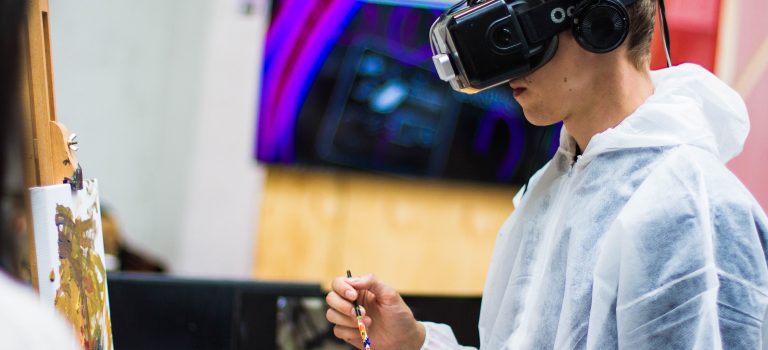
While just a few years ago, a transition to online learning at the current scale would have been unimaginable. It was impossible to imagine a 100 percent  online degree in a discipline that requires hands-on experience – such as sculpture. However, professors are pioneering new methods and ed-tech companies are developing new platforms. A professor at New York University’s Tisch School of the Arts taught a drama course that allows students to “act” with each other in virtual reality using Oculus Quest headsets; while a music professor at Stanford trained his students on software that allows musicians in different locations to perform together using internet streaming. “It’s a little more difficult to move fine arts to the online education arena, but it’s not impossible,” says Andy Fulp, Dean of Educational Technology for the Savannah College of Art and Design (SCAD), which offers online degrees in various fine arts fields.

Experts believe that the future for the universities that wish to stay up-to-date lies in creating “parallel” online degrees for all their core degree programs. By doing so, universities could expand their reach by thousands, creating the economies of scale to drop their costs by tens of thousands. Some instructive examples are already available – e.g. in Georgia Tech, a top engineering school, who launched an online masters in computer science in 2014 and now has nearly 10,000 students enrolled, which makes it the largest science programme in the US. The case demonstrates that the online degree programme has not cannibalized the in-person one, but rather opened up an opportunity to a different target group, mostly midcareer applicants looking for a meaningful skills upgrade. There is no reasons why fine arts cannot follow this path.

With all the advantages of online learning, virtual degrees are becoming increasingly popular option. According to The National Center for Education Statistics, in 2016 alone, nearly 6 million students in the US — over 28 percent of all college learners — were enrolled in at least one online course at a degree-granting college or university.  Of those students, over 2.8 million, which makes 13 percent of all college learners, did not take any in-person courses, completing their degrees exclusively online.

With so many online learners making up the student body at top institutions, a shift in how people – and most importantly, employers – perceive online degrees is inevitable. The stigma attached to this form of education slowly disappears and companies are adjusting their hiring practices.

In a survey done by online institution Excelsior College and Zogby International, 61 percent of CEOs and small business owners nationwide said they were familiar with online or distance learning programs. As many as 83 percent of them see an online degree at a reputed institution as having the same value as an on-campus degree.

This opinion is shared by 61 percent of HR leaders. On top of that, 52 percent of them believe that, in the future, most advanced degrees will be completed online. Today already, they hire job applicants with online degrees – 71 percent of organizations claim they have done so in the last 12 months.

However, where you receive your online degree makes a significant difference in how employers will view your credential. Employers said such factors as the accreditation of the college or university, the quality of its graduates and the name of the institution awarding the degree were among other things they considered to make an online degree more credible. In fact, 58 percent of employers “believe that an institution’s brand and reputation is the main driver of a credential’s value, regardless of whether or not it was earned online.”

Among other factors that inspire trust among employers is the fact that an online degree is offered by an institution that provides traditional on-campus programmes in addition to its online coursework. This is based on the employers’ presumption that brick-and-mortar schools dedicate the same time and attention to developing online courses as they do for in-person courses. According to the Society for Human Resource Management (SHRM), 92 percent of employers view online degrees from brick-and-mortar schools as favorable, while only 42 percent would consider a candidate with an online degree from a university that operates solely online, despite any accreditation.

Despite all the ever growing popularity of online degrees, the debate around them continue unabated. No matter which one you choose – online or traditional – make it an informed decision and make sure the school you choose is accredited and reputable. BE OPEN Academy is always here to help you make the choice.

BE OPEN on Design Thinking: Foundation of Success or Fraud? Pt 2

BE OPEN on Design Thinking: Foundation of Success or Fraud? Pt 2

Proponents of Design Thinking claim that institutes, like the Hasso Plattner at Stanford, can be places of real exploration and new forms of teaching and research. However, some educators and designers air an opinion that design thinking has warped into something superficial that has little to do with actual design.

Unexpectedly, in his much-talked-of article Design Thinking is a Failed Experiment, one of Design Thinking’s biggest advocates Bruce Nussbaum, formerly the editor of BusinessWeek, points out that the methodological framework has given the design profession and society at large all the benefits it has to offer and is beginning to ossify and actually do harm. So, what can be wrong with this human-centered approach that is supposed to provide a new generation of designers with problem-solving thinking and unlimited creativity?

In June 2017, the graphic designer Natasha Jen, a partner at the design firm Pentagram, gave a talk titled Design Thinking is Bullshit. Jen explains that Design Thinking takes a thoughtful, complex, iterative, and often messy process and dramatically oversimplifies it in order to make it easily understandable, delivering it as a manufactured series of sterile steps and ignoring the rich set of tools and methods that designers have for doing their work and challenging themselves. According to Jen, “Design Thinking packages a designer’s way of working for a non-design audience by way of codifying design’s processes into a prescriptive, step-by-step approach to creative problem solving — claiming that it can be applied by anyone to any problem.”

This is echoed by Jon Kolko, Partner at Modernist Studio, and the Founder of Austin Center for Design, who is convinced that intellectual design thinking cannot replace but can only support practiced skills in form giving, in iterative prototyping, in design fundamentals like composition, color theory, and sketching, and in creating things that people actually use – i.e. it cannot replace actual ability to design. He recalls that even Tim Brown, the CEO of IDEO who popularized design thinking, studied design at both Northumbria University and the Royal College of Art, and worked as a practicing designer. “When we make things—again, the word things is used loosely, applying to both a toaster and a business strategy—we become intimate with details, with material, with complexity, and with simplicity. We iterate and immerse and explore and craft,” Kolko explains.

In the meantime, Design Thinking trivializes the role of craft and making things, which is fundamental to the process of design. Most people practicing popularized design thinking haven’t explored psychology of problem solving, they do not bother with real and meaningful empathetic immersion in the context of social problems and, given their emphasis on innovation, often choose to completely ignore what the university was designed to promote – the past.

This results in a split-off within the design world. While some institutions and firms are driven by practitioners aware of the history of making things and skilled in the craft of making things, others practice design thinking in a dramatically different way – not by making things, but by thinking about them. This, in its turn, leads to the fact that students graduate design-thinking-centric academic programs without the ability to actually design things. Design has its roots in the creation of things, while students of design thinking often don’t have “craft skills.” In his argument against design thinking, Lee Vinsel, Assistant Professor of Science, Technology, and Society at Virginia Tech, describes how studying design thinking gives students an unrealistic idea of design and the work that goes into creating positive change. “Upending that old dictum ‘knowledge is power,’ Design Thinkers give their students power without knowledge, ‘creative confidence’ without actual capabilities,” writes Vinsel as he unveils that individuals working in art, architecture, and design schools tend to be quite critical of existing Design Thinking programs. Reportedly, some schools are creating Design Thinking tracks for unpromising students who couldn’t hack it in traditional architecture or design programs — DT as “design lite.”

‘Lite’ seems to be a great word to describe many aspects of Design Thinking. Design thinking is often dressed up as fun work, rather the serious kind. What lies underneath is that ideation sessions encourage positive thinking at the expense of critical thinking.

Vinsel insists that the entire model of design thinking is based on design consulting and is just a package sold by consultants and universities. While most proponents of design thinking are impressed by the method’s Empathize Mode, again it is “empathy lite” that is promoted, for a true empathetic and meaningful connection with people cannot be forged in hours or even days. The d.school’s An Introduction to Design Thinking Process Guide describes the Empathize Mode as “the work you do to understand people, within the context of your design challenge,” and this is nothing else than one of the most vital business rules “Listen to your client” in order to understand their problem and discover what they need.

Nussbaum agrees saying that “by packaging creativity within a process format, designers were able to expand their engagement, impact, and sales inside the corporate world. Companies were comfortable and welcoming to Design Thinking because it was packaged as a process”. Design Thinking has become a tool of consultancies to sell work, not to drive real impact.

Thom Moran, an Assistant Professor of Architecture at the University of Michigan, believes that Design Thinking treats design as marketing. “It’s about looking for and exploiting a market niche. It’s not really about a new and better world. It’s about exquisitely calibrating a product to a market niche that is underexploited.”

“In the end, Design Thinking’s not about design,” Vinsel sums up. “It’s not about the liberal arts. It’s not about innovation in any meaningful sense. It’s certainly not about ‘social innovation’ if that means significant social change. It’s about commercialization.”

From this prospective, rolling out the d.school’s model would mean using design consulting as a model for reforming education. In this paradigm, students should be treated as customers, or clients, and educators should make sure our customers are getting what they want. This approach implies that Design Thinking should be a central part of what students learn, so that graduates come to approach social reality through the model of design consulting. In other words, we should view all of society as if we are in the design consulting business, which honestly has little to do with the true meaning of design and innovation.

From Nussbaum’s point of view, Design Thinking from the very beginning was a scaffolding for the real deliverable: creativity. Denuded if the mess and conflict, which are part and parcel of the creative process, in order to appeal to the business culture of process, it fails to deliver. Still, one should not discount contributions of Design Thinking to the field of design and to society at large. It managed to move designers from a focus on artifact and aesthetics within a narrow consumerist marketplace to the much wider social space of systems and society – it made design system-conscious.   The future will show if, supported by applicable craft skills and training, as well as the knowledge of history of making, design thinking could provide a framework in which humanists and scientists could work together on problems that need to be solved, such as climate, food, poverty, health, transportation, or built environments – or it should give way to new paradigms.