



Update: BOA added 6 free video tutorials offered by Howard Pinsky
Month: June 2024
Global Art
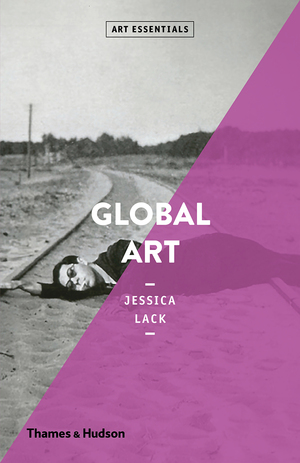
Author: Jessica Lack
An essential guide to the multifaceted and increasingly connected global art community from 1900 to today.
Global Art introduces some of the most significant art movements of the twentieth and early twenty-first centuries that have challenged the status quo. Featuring fifty artistic developments from every continent, this volume covers movements born of decolonization, marginalization, and conflict. Ranging from the Saqqakhaneh artists of Iran to the Stridentists of Mexico, Experimental Workshop of Japan to America’s AfriCOBRA, it chronicles groups that have empowered and given voice to their members.
Packed with bold and illuminating illustrations, the book demonstrates the distinct but connected roles of global movements in creating cross-cultural dialogues in today’s art world. Journalist Jessica Lack provides historical context for each art movement, key cultural events, and interconnections, bringing to life the protagonists in each movement’s evolution.
Mary Cassatt: Painter of Modern Women by Griselda Pollock
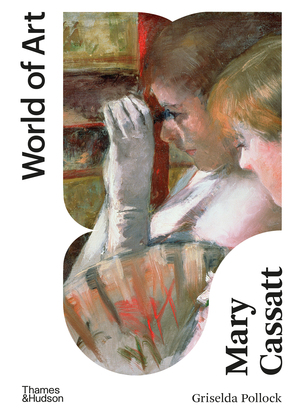
This groundbreaking study redefines the status of the beloved American artist Mary Cassatt, placing her work in the wider context of nineteenth- century feminism and art theory. Mary Cassatt looks at the artist’s work in light of her time as an advocate for women’s intellectual life and political emancipation. Esteemed by her contemporaries for her commitment to what she and her radical colleagues in Paris termed “the new art”—now called impressionism—Cassatt brought her discerning gaze and compositional inventiveness to the study of the subtle, often psychological, social interactions of women in public and private spaces.
Focusing on key moments of engagement and change over the artist’s long career, art historian Griselda Pollock discusses Cassatt’s artistic training across Europe, her profound study of the old masters, and places fresh emphasis on the artist’s interest in Manet and other contemporary French and Spanish painters as well as her influence on American collections of French modernism. Now revised with a new preface, updates to the bibliography, and color illustrations throughout, this book offers a reevaluation of the work of this important artist as seen through the frames of class, gender, space, and difference.
Find out more about Mary Cassatt: Painter of Modern Women by Griselda Pollock →
Update: BOA added 5 new online courses in Game Design offered by One Education
Update: BOA added 5 new online courses in Game Design offered by One Education
Arts Education Imperatives: Connecting the Globe (Pt.2)
Phase 1 focussed on the 2019 UNITWIN symposium in Winnipeg, and subsequent Yearbook, Visions of Sustainability for Arts Education: Value, Challenge and Potential (Bolden & Jeanneret, 2021). Chapters were contributed by UNITWIN members and their colleagues from nine countries in Oceania, North America, Asia, and Africa. Researchers from Australia, Singapore, China, and Germany referred to aspects of cultural sustainability via artistic cultural learning and this theme overlapped with many references to community arts and engagement. Authors also addressed the significant role of digitalisation, both in sustaining culture by allowing and supporting its expression and in shaping culture and cultural products. The theme of honouring voices also featured, often manifested in the research methods that authors employed, while accessibility was highlighted in work from Korea, Canada, Kenya, and China. The editors identified four prominent themes across the contributions – cultural sustainability, community, honouring voices, and accessibility (Bolden, Jeanneret, & Kukkonen, 2021).
Phase 2 followed a COVID-induced break and focussed on the 2021 UNITWIN Symposium hosted online by the Korea Arts and Culture Education Services in May with presenters from 13 countries and 575 delegates from 38 countries. Jörissen’s keynote seemed to capture the essence of what was to come and began with the word “resilience”, “a much sought-after capability in times of crises” that “can be related to individuals, collectives (e.g. communities) and even entire systems (e.g. societies)” and a concept that “is especially important at a time when societies – on an economic, ecological and cultural level – are exposed to a multitude of transformations” (Jörissen, 2021a). The closing ceremony called upon UNITWIN members to comment on presentations and from this synthesis came many insightful observations and recommendations. For example, the impetus for, and value of, sharing globally was noted by Akuno, while Leung remarked on research that demonstrated the arts capacity to reflect real stories, countering official languages and focussing on different ethnicities. Themes emerging from this phase included social and cultural inclusiveness, diversity and cultural representation, cultural and aesthetic resilience, the arts for healing, and sustainability.
Phase 3 occurred in July 2021 with UNITWIN members presenting research with discussions over two Zoom sessions. Spurred on by an increasingly focussed consideration of arts education issues that are global in scope, the group endeavoured to find parallels between their individual research agendas and the emerging themes outlined in previous phases. While contexts differed, similar themes to previous phases emerged, along with a distinct and sharper focus. For example, from contexts as diverse as Colombia and Hong Kong came the notion of balancing access to learning about Indigenous arts with that of imposed Western knowledge systems and ways of preserving and invigorating local musics. Research from both Kenya and Columbia highlighted how limited access to the internet for many has only been exacerbated by increased reliance on it during the pandemic. The nature of engaging with and teaching Indigenous knowledges was also identified as a common area of interest, along with the limitations of engaging with such teaching via digital technology. While the power of the arts to contribute to wellbeing was acknowledged, the notion of the “arts for art’s sake” was seen as diminishing. Several themes emerged from the synthesis of these presentations and discussions: inclusion; the effects of colonisation and balancing Western and Indigenous cultures; cultural identity and resilience; the impact of the pandemic on disadvantage and access to arts education; and the omnipresent digital world.
Phase 4 involved a process of further iterative and reflexive thinking. The challenge was to distill and synthesise these emergent themes into a manageable conceptual form. We developed a conceptually clustered matrix (Miles, Huberman & Saldana, 2014) to group and sort the emergent themes, which enabled us to identify four categories that we have described as “imperatives”. These imperatives characterise a global compendium of research in arts education occurring over the last two years. The representation in Figure 2 shows the imperatives, and attempts to capture how they overlap, connect and are interdependent and interrelated.
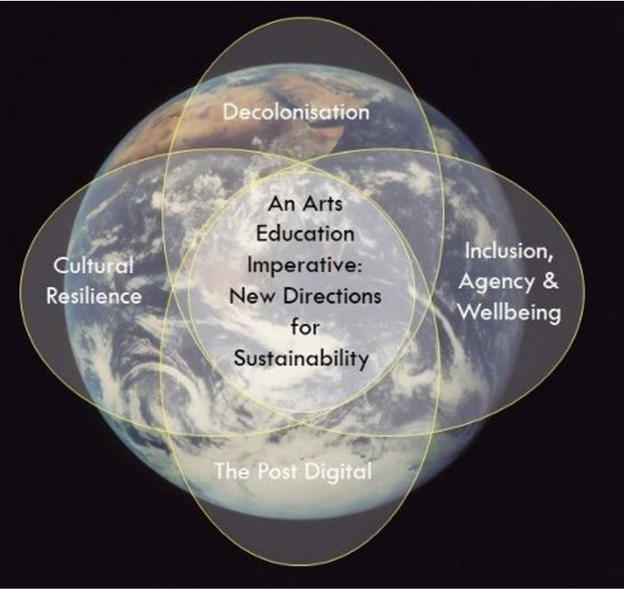
Figure 2. Intersecting Imperatives.
Having identified these four imperatives, we used them as a framework for a successful University of Melbourne Research Development Grant in August 2021 with the Melbourne Graduate School of Education arts education team and partner investigators from UNITWIN members in Canada, Kenya, Singapore, Germany, and Hong Kong: An Arts Education Imperative: New Directions for Sustainability. The Project aimed to develop a foundation for generating international and national research collaborations with one of the main outcomes being to develop an open access digital repository of research to consider the four imperatives, while also interrogating further the ideas and concepts proposed in the framework and what they may mean within and across different arts disciplinary boundaries.
Given our aim was to ensure the digital platform was sustainable and accessible for ongoing collaborations across locations, we identified the open-access reference-management tool, Zotero, as the most appropriate digital repository for this purpose. The approach we adopted to establish and contribute foundational literature about the proposed imperatives to the platform also involved aspects of bricolage such as ‘feedback looping’ while also having an anchor or ‘point of entry text’ (POET), that prompted the initial inquiry that can be continually revisited to identify new lines of inquiry (Kincheloe & Berry, 2004) were employed. We also used the elements of progressive focussing (Hammersley & Atkinson, 2019) we referred to earlier.
Based on the four imperatives, nine sub-terms (decol*1 , culture, resilience, inclusion, agency, wellbeing, post-digital, digital, arts education) were used to undertake a literature scan of databases such as ERIC, EBSCO Education Research Complete, and ProQuest Arts Premium Collection. In tandem, abstracts and reference lists from project partners’ research were used to identify further germane literature. A protocol was developed for identification, screening, and eligibility to establish inclusion and exclusion criteria. When sources were deemed appropriate to be included, they were entered into the Zotero reference-management platform and coded according to its relevance with each of the four imperatives by considering key terms and automatic tags imported through Zotero. To assist in effective searches within the Zotero platform, we also extended the tagging system, and codified various authors’ affiliated institutions, and the geographical sites of research studies into the database to provide data for manipulation in various digital applications to generate geographical maps. Having identified these initial bodies of literature, which we hope will grow in time, as initial POETs, we are also aware that this literature and research over-represents voices and perspectives from the global north, which we also hope can be addressed.
The Zotero library is free and publicly available to others who may way to search for literature or provide additional sources to contribute to the site (MGSAE, 2021). We also see the site as another avenue to connect with colleagues who are working in the field of arts education, thereby providing an opportunity for various types of collaborations and for others to engage with, and contribute to, the project. Having discussed both the methodological aspects of the project and the digital literature repository, in the following section, we outline some initial understandings of these imperatives. We distill key ideas from some literature we have listed in the Zotero repository, and we discuss how these ideas are reflected in the work of researchers associated with the AERCDSD network.
Authors: Emily Wilson University of Melbourne, Neryl Jeanneret University of Melbourne, Mark Selkrig University of Melbourne, Jenni Hillman University of Melbourne, Benjamin Bolden Queens University (Canada)
Citation: Wilson, E., Jeanneret, N., Selkrig, M., Hillman, J., & Bolden, B. (2023). Arts education imperatives: Connecting the globe. International Journal of Education & the Arts, 24(4). http://doi.org/10.26209/ijea24n4
Building for Change. The Architecture of Creative Reuse
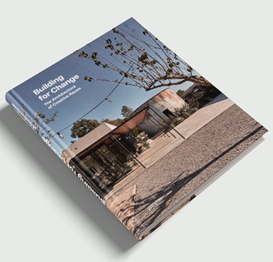
Editors: gestalten & Ruth Lang
How can we build a sustainable future in a time of climate change and dwindling resources? As our spatial needs begin to evolve more rapidly, architects are exploring ingenious ways in which to reuse and recycle existing buildings; resulting in a stunning transformation of our existing urban fabric.
Building for Change collects the strategies of reuse together, demonstrating their power for change through groundbreaking projects from some of the world’s leading architects.
Free download exhausted