





BE OPEN: 10 Ways AI Is Transforming the Education and Learning Sectors

BE OPEN: 10 Ways AI Is Transforming the Education and Learning Sectors

Various industrial sectors are witnessing the crazy impact (in a good way!) of Artificial Intelligence (AI) as a powerful technology. This also applies to the education sector worldwide. There are different educational institutions around the world utilizing Artificial Intelligence for different purposes. Students, teachers, parents, and of course the educational institutions themselves, now view education from a wholly different perspective as a result of Artificial Intelligence. As an outcome, custom eLearning solutions developed with the integration of Artificial Intelligence are also gaining traction.

Want to see the actual impact of AI in education? Let’s go through some figures to help explain how Artificial Intelligence is utilized in the educational sector:

  • According to a report by Global Market Insights, AI in the education market is predicted to exceed $80 billion by 2030.
  • The Markets and Marketsreport suggests that global use of AI in the education market could grow up to $3,683.5 million in 2023.

Whoa! That’s a huge impact. Apart from other things, teachers can now use real-life examples to help their students learn more effectively and quickly, all thanks to AI technology, which has also revolutionized the way teachers teach. If utilized properly, AI has the power to transform the educational landscape. Hard to believe? Okay, let’s explore the incredible implementations of Artificial Intelligence in the educational sector.

Implementation Of Artificial Intelligence in the Educational Sector

1. Automated Assessment and Grading Tasks

A significant amount of time that could be spent on class preparation or educating students is spent grading their homework and assignments. While it is clear that Artificial Intelligence cannot fully replace a teacher, it can however be used to assess student performance on multiple-choice or fill-in-the-blanks tests and provide grades.

2. AI-Based Intelligent Assistants

Students can now have access to educational resources without contacting teachers, thanks to AI-powered assistants. As an example, Arizona State University employs Amazon Alexa to assist students with routine school responsibilities and activities. Students can ask questions to Alexa, and she responds and directs them to more resources.

3. Smart Content

An AI-based custom eLearning solution can effectively manage and analyze massive data (like different online learning resources) to gather the necessary information for students. With their custom cloud platforms, organizations like Byju’s, Netex Learning, Jaro Education, etc. help students by delivering special lectures, conducting conferences, virtual training sessions, and other educational services.

4. Personalized Education

AI can assist teachers in providing personalized teaching so that students can learn at their own speed. Some well-known educational platforms, like Carnegie Learning, currently provide customized courses using Artificial Intelligence. The use of AI technology can also be beneficial in delivering personalized instructions.

5. AI-Powered Tools for Constructive Feedback

Colleges, schools, and other educational institutions that already provide online programs use AI-based tools to monitor student development and notify teachers about student performance.

6. Keeping Track of Student’s Performance

Teachers can monitor student performance using AI-based teaching tools and determine where or how much improvement is needed.

7. Creating Courses

Artificial Intelligence also powers custom eLearning solutions which can assist professors in bridging the knowledge gap between their lectures and the study materials. Such software can help them to create personalized courses and figure out how to make them better so they can educate better. For instance, Coursera, a well-known provider of online courses, already uses this technology to notify teachers whenever students submit the wrong response to a question.

8. AI-Based Tutors

Although having an AI-based tutor is still a fantasy, given how quickly this technology is developing, it may not be long before it becomes a reality. There are currently some AI-based tutoring tools available in the market to assist students in learning mathematics, basic English, and other subjects.

9. Greater Involvement

Students can now discuss the difficulties they are having in learning a certain subject or understanding a topic on different AI-based platforms. These platforms are a good technical approach to interacting with peers and exchanging ideas and knowledge, which eventually boosts student engagement.

10. Enhanced Teaching and Learning

Teachers can help students in understanding a concept better by using a variety of AI-powered technologies. To explain how things operate, they can utilize real-life examples and demonstrate them to the students.

In Conclusion

The field of education is gradually being transformed by Artificial Intelligence. It has the potential to revolutionize how students learn and modify how teachers and educational institutions carry out their duties. You are now familiar with some of the best applications of Artificial Intelligence in the educational sector.

Furthermore, it is undeniably true that Artificial Intelligence has revolutionized traditional methods of education and teaching. This is why universities, colleges, and other educational institutions are making significant investments to integrate AI into their curricula. This technology has several benefits, including the ability to teach students, automate tasks like grading, update educational software, assist in course improvement, and much more. On a brighter note, one may predict with certainty that the educational sector will be very different in a few decades as a result of AI. Isn’t it remarkable?

BE OPEN: Best Art School Alternatives: Affordable & Accessible Education

BE OPEN: Best Art School Alternatives: Affordable & Accessible Education

A school of art teaches you technical and creative skills, the business side of art, networking, and how to develop an artist’s attitude. These things are hard to learn on your own and require guidance from people with experience in careers in art.

Pros and Cons of Formal School

There are pros and cons of attending a school of art.

Pros:

  • Discipline: The demands of deadlines teach you to develop a habit of consistent work
  • Mentors: Good instructors help you develop your strengths and minimize weaknesses
  • Networking: Making acquaintances, both students and teachers, can build a network for later support and opportunities

Cons:

  • Cost: Tuition is the biggest drawback. Good schools of art aren’t cheap, and loans can leave you with student debt that alternative schools don’t
  • Pressure: While deadlines can help you to build discipline, they can also take some or all the fun out of art making
  • Prescribed Curriculum: You are stuck with the knowledge and skills the school thinks you should learn and how you should learn them, like doing research projects

Can You Be an Artist Without Going to School?

You can become an artist without going to a school of art. If you are a self-starter, disciplined, and have a passion for art, you have a good chance of becoming a professional artist.

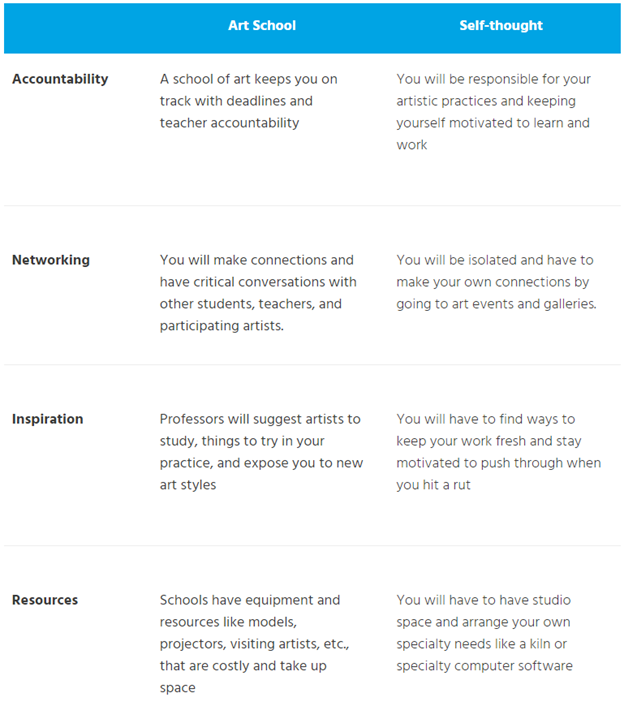
By art school, we mean any commercial program that offers a structured curriculum and feedback, whether online or in person. Self-taught means you read and research techniques in books and online and practice under your own direction.

School vs Self Taught

Art Mentorships

Finding an art mentor can be a good idea whether you go to school or not.

What Does an Art Mentor Do?

An art mentor is like a sounding board for ideas for artworks, methods of artmaking, finding opportunities for selling your work, or other topics of critical engagement a professional artist will have experience with. Most often, they are paid, but sometimes, you can develop a relationship with a late-career artist who just wants to help younger artists.

Are Art Mentorships Worth It?

Art mentorships are worth it if you find the right person and have specific goals. You can learn things from an experienced artist that you won’t find in internet searches, and they will help you discover any blind spots you have around your art. Learning from someone else’s mistakes and experiences can save you time, money, and frustration.

Piero Lissoni: Environments

Piero Lissoni: Environments

Edited by Stefano Casciani

With offices in Milan and New York, Lissoni & Partners has a 30-year history in developing international projects in the fields of architecture, landscape, interior, product, and graphic design, as well as acting as art director for a range of prestigious companies.

Led by Piero Lissoni, the practice combines a range of expertise with a tailored approach that sets it apart, establishing a stylistic code and a visual identity that are clearly recognizable. The works are inspired by a sense of rigor and simplicity and are characterized by a regard to detail, coherence, and elegance with particular attention to proportion and harmony.

The book, edited by Stefano Casciani, is the first far-reaching monographic study on Lissoni, richly illustrated with photographs, floor plans, and sketches. It is structured by theme and includes Lissoni’s most important projects for industrial and residential architecture, as well as commercial and public spaces, museums displays, boats, graphic design, and product design.

Find out more about Piero Lissoni: Environments →

The Colour Bible by Laura Perryman

Color Bible

The Colour Bible is an essential and inspirational guide to colour in art and design. It’s a succinct book covering 100 significant colours and their pertinence and potential for use in the world around us.

Colour is multifaceted, without an understanding of the fundamentals of colour theory and understanding of how colour affects us – it can feel overwhelming. The book clearly highlights the foundations of colour, with tips on how to use colour for the better – to improve user experience and create improved palettes. There are cues of how to make successful but also intelligent palettes with each of the colour entries.

It’s chaptered by the spectrum red, yellow, orange, blue, greens, pales, darks and browns. Each chapter explores each colour area.

Every colour profile starts from the colour’s origin then tracks its evolution, historical use and where it lands today – the then and the now. Each entry finishes with a suggestion for the modern utility of the colour.

It’s visual – it was always going to be! Using examples of art or design to unpick individual colours, their histories, material origins – and demonstrates how they have context and relevance in today’s world – and showcases more advanced forms of colour, natural colour, and colour trends highlighting where they are heading.

BE OPEN: Gamification In EdTech: The Future of Innovative Learning. Pt.2

BE OPEN: Gamification In EdTech: The Future of Innovative Learning. Pt.2

Implementing an intelligent and wise business approach to Edtech solutions for innovation, ease, and interactivity, gamification in eLearning is the next big innovation in the field.

Lessons With Games

When it comes to gamification, EdTech companies get a chance to encourage students with better concentration abilities and cognitive stamina. Moreover, gamification even helps to make things more fun and favorable for real-world situations. Above all, learning is all about inspiring the users with an innovative and engaging learning process. Gamification could help users by offering illustrations that trigger fascination for even the trickiest subjects.

Rewards With Gamified Learning

Another significant reason why the EdTech industry needs to invest in gamified learning is to exercise some control over the hours spent learning a module. With games and visuals, students can be introduced to a time slot during which they can interact with the application to avoid any unwanted stress and ensure value from the time spent. Also, students who show the most productivity in the given amount of learning time can be rewarded with level-up certifications. The most complicated and time-consuming subjects can be introduced to students with a smart approach to teaching, using gamification.

Relieving Stress and Improving Relationships

Last but not least, the gamification of EdTech helps students to explore new concepts and subjects in an innovative manner. The use of gamification techniques in eLearning applications could even aid the relationship between students and tutors while mitigating the whole hassle of standardizing apps. Students who are involved in the educational relationship through gamification could get more streamlined exposure to concepts. Also, gamified learning relieves the pressure that students might otherwise experience when taking tests in a physical environment. All in all, students and teachers who are tired of the extensive anxiety that they experience with the traditional approach to education could foster gamification to avoid the struggles associated with the standard academic process.

The Crux: Future Of Gamification in EdTech

In conclusion, the whole concept of gamification works by increasing the interactivity of the learning platforms. Gamification not only helps students to learn easily but also makes their learning journey a more enjoyable process. It helps students to be more proactive and relaxed during the learning cycle, while also giving them the chance to learn without any fear of errors or mistakes, especially when students get a chance to develop their skills with exposure to easy learning techniques. The EdTech industry is very likely to add more revenue and growth with the integration of gamification.

Moreover, the advanced learning medium could make it easier for teachers to offer their courses to a greater number of students. EdTech and gamification are concepts that are made to complement each other in the near future while allowing for more expansion in the industry. However, bringing these two concepts together equally demands a sophisticated and thoughtful approach to quality assurance. For educational institutions to offer a streamlined and dynamic learning environment to students, they must ensure a consistent sharing of information that would require the effective involvement of EdTech testing solutions.

It is equally important for the EdTech industry to understand that working alone on gamification could minimize the chances of exposure and the chances of moving ahead of the competition. Rather, the integration of other technologies like AI, VR, etc. can be pursued to get the growth that the EdTech industry is expecting in the upcoming years. In a nutshell, the path to success for gamification in EdTech is all about innovation, brought into the eLearning scenario through an intelligent and wise business approach. If you can make gamification in learning interactive and easy to pursue, for teachers as well as students, you are all set to stay ahead of the game.

BE OPEN: Gamification in EdTech: The Future of Innovative Learning. Pt.1

BE OPEN: Gamification in EdTech: The Future of Innovative Learning. Pt.1

Gamification Is Redefining the Future of eLearning

In recent years, the concept of EdTech has transformed completely. From interactive learning based on animations to applications, students and enthusiasts from all age groups have experienced the benefits offered. However, another interesting transition that has brought a very positive change to the EdTech industry is the introduction of gamification.

From the time that gamification has become a buzzword for the industry, a study from BlueWeave Consulting has found that the global education gamification market was worth USD 697.26 million in 2020 and is further projected to reach USD 4144.97 million by 2027. But still, EdTech start-ups and existing brands are looking for some fresh perspective on how gamification could redefine the future of learning.

The pandemic acted as a catalyst for the concept of gamification, as it propelled all educational institutions to foster hybrid learning environments. The need for improving engagements made educators especially look to gamified learning as an advanced approach to eLearning. The whole idea of gamification in EdTech was introducing the video game kind of layout or interface to encourage interactive learning.

In this article, we will try to highlight how gamification could bring necessary innovations to the EdTech industry while also highlighting the several benefits and scenarios surrounding the use of gamification in remote learning.

Unraveling Gamified Learning in EdTech

With the objective to continue offering learning during the pandemic, innovation took the front seat when it came to the education industry. From advanced learning modules that help students explore their interests in programming languages to free subscription models, things took a leap. A similar kind of interest in innovation was observed at the parents’ end, with parents who were more ready than ever to invest in technology that could encourage learning. These included the use of DIY kits or STEM toys that offer digital content to cut through the constraints and deadlines of learning with standard practices. Besides, the introduction of personalization with AI triggered innovations such as Augmented Reality (AR) and Virtual Reality (VR).

Innovative Learning

Gamification is the future of innovation in the EdTech industry. The introduction of AI, Big Data, cloud technology, IoT, mobile learning, and VR all have the potential to enrich gamified learning. This gives encouragement to game-based learning methods at schools, to keep students interested in the learning process. Moreover, gamification increases the chances of the practical application of educational concepts, as it gives students a chance to use their imagination. With a more detailed introduction to real-world applications of subject matter, gamified practices would facilitate teachers to coach students. More importantly, gamification could help market EdTech solutions while gaining insights into the effectiveness of applications on immersive technologies.

Comfort And Interactivity

With time, the idea of learning is no longer restricted to students. From training professionals to capturing young minds, employing gamified elements in applications could help make learning a more compelling task. Such elements usually include quizzes, puzzles, scenario-based questions, or graphical representations of the subjects that the students need to learn. Besides, it is important that EdTech companies help teachers and coaches to create easy-to-follow learning spaces. To help create a pleasing learning experience for students, the instructors must be provided with thorough guidance on balancing fun elements with theoretical learning, which is quite an easy task to pursue with gamification.

Engagement And Competition

When it comes to industry experts and even the people who have not yet used gamification in learning, there is a belief that gamified learning has all that is required to increase student engagement. However, gamification also poses a continuous threat of competition to all those learning platforms that refrain from using the concept or believe in the value-generating potential of legacy practices. This competition factor is even reflected in students when some particular students are performing better using gamification techniques than by using methods associated with other trends in online education. Nevertheless, gamification has the potential to create a fun, engaging, and competitive environment for the students. For instance, the use of technology like VR headsets in applications could help create a hands-on learning experience, creating a more holistic and practical learning environment.

The Creative Act: A Way of Being

Author: Rick Rubin

The Creative Act is a beautiful and generous course of study that illuminates the path of the artist as a road we all can follow. It distills the wisdom gleaned from a lifetime’s work into a luminous reading experience that puts the power to create moments–and lifetimes–of exhilaration and transcendence within closer reach for all of us.

Many famed music producers are known for a particular sound that has its day. Rick Rubin is known for something else: creating a space where artists of all different genres and traditions can home in on who they really are and what they really offer. He has made a practice of helping people transcend their self-imposed expectations in order to reconnect with a state of innocence from which the surprising becomes inevitable. Over the years, as he has thought deeply about where creativity comes from and where it doesn’t, he has learned that being an artist isn’t about your specific output, it’s about your relationship to the world. Creativity has a place in everyone’s life, and everyone can make that place larger. In fact, there are few more important responsibilities.

Find out more about The Creative Act: A Way of Being →