




Update: BOA added 6 new online courses in Graphic Design and Animation offered by LinkedIn Learning
Author: JD

Context In eLearning: 6 Tips to Help Online Learners Contextualize
The Importance of Context in eLearning and How to Help Online Learners Contextualize
Building context is essential in eLearning. You can spend hundreds of hours building an eLearning course packed with features, clear navigation, and visual cues. All will be for naught if you haven’t considered the online learner’s perspective. Fail to analyze your audience and you could be pitching the detail too high, or even too low. You risk disengagement if online learners don’t understand why they are expected to absorb this information. If they can’t see how the eLearning course is relevant to their role, they will simply not engage. Building context from the first communication is vital in motivating your online learners.
Putting Learning in Context
Context is what provides the framework for the training. Why is this information important to the online learner? How is it meaningful? How will it help them and what value will it bring? Develop your eLearning course from a perspective that helps your online learners understand how it will help them improve. To develop a context in eLearning, you must connect the learning with an individual’s values, interests, motivations, and attitudes. This is more difficult when you are teaching a complex or technical topic. Searching for the real-life impact of gaining technical knowledge is the key to unlocking the online learner’s motivation. Help your online learner to really care about the subject by giving them a story they can relate to. Provide something to which they can make an emotional connection.
6 Tips to Help Online Learners Contextualize Information
The real key to setting the context in eLearning is storytelling and branching scenarios. Put your online learners in the picture, allow them to feel that the training is central to their role. Let them see how they as individuals fit in with the branching scenario. Then show how it will, in turn, improve their own experiences. While developing your eLearning course, bear in mind how it will engage and motivate online learners. They should see the eLearning course as an essential part of their personal development, a part they are keen to fulfill. Follow these 6 tips to help online learners to understand the context for their learning journey.
1. Analyze Your Audience
Take the time to understand your audience. You need to appreciate their perspective. This could include prior knowledge (or lack thereof), and any experience with eLearning. Make sure you consider demographics like diversity, language, and culture. It’s also wise to factor in their work duties and tasks to create resources that resonate with them on a personal level. Conduct surveys and focus groups to learn as much as you can about their needs and expectations.
2. Collect Online Learner Feedback
Gather as much feedback during the development stage as possible. Involve online learners early and often. They will be able to guide you to assess important aspects of the eLearning course, such as whether learning objectives are being met, if eLearning content is meaningful, etc.
3. Incorporate Self-Guided Study
Allow for gaps in knowledge by providing links to further reading, online resources or Subject Matter Experts. Give online learners access to an appropriate forum for social learning, so that they can learn from their peers. Allow them to ask questions and receive helpful answers. You can also invite them to host their own live events or forums to summarize the key concepts. Thereby, contextualizing the information and improving eLearning content comprehension for others.
4. Clarify Learning Objectives
Set out learning objectives and goals from the outset and link to them throughout. This will help online learners to understand how the eLearning course relates to their everyday role. It will be a powerful motivator to engage with the eLearning course. Add functionality to track individual progress; learning paths, progress bars and badges all help keep online learners interested.
5. Provide Real-World Examples
Real-world examples, case studies, and personal anecdotes evoke emotion and tie the subject matter into real-world situations. For instance, customer service employees can see how certain skills help them on the job. Thus, they’re more likely to actively participate, knowing that it will benefit them in the workplace. The key to creating contextual examples is to use characters online learners can relate to. It’s also crucial to explore the ‘why’ behind their motivations and actions. For instance, the reason why the character performs the task in a certain way.
6. Create Simulations to Put Knowledge into Practice
Simulations are all about immersing online learners in virtual environments that mimic the real world. As a result, they’re able to apply what they’ve learned in a practical context. Ensure that your simulations feature relatable situations, characters, and challenges to enhance the engagement. You should also encourage online learners to reflect on the eLearning activity after the fact to improve understanding. For instance, what might they do differently in real life to fix their simulated mistakes? Which obstacles or problems will they be able to tackle with their newfound knowledge? Reflection allows them to connect the eLearning experience to their personal goals and gaps.
Having context in eLearning can be summarized as creating an environment that is familiar to online learners. It should show them what they, individually, will gain from the eLearning course. It recognizes the online learner’s background and their perspective on the eLearning experience. Providing context in eLearning unlocks the motivation and gives them a reason to connect with the eLearning course. eLearning content with no consideration for context will fail to engage an online learner on an emotional level. Topics which are heavy on technical terms, such as legal or compliance courses, must be especially aware of this risk. Above all else, remember that completion of an eLearning course is rarely the goal. Provide context in eLearning and you will drive engagement, connection, and behavior change.
Evoking positive emotions in online training plays a pivotal role in increasing employee engagement and motivation. Read the article 8 Tips To Foster Emotional Connectivity in Online Training to discover how to make online training personal and foster emotional connectivity in online training.
The Shape of Design
Author: Frank Chimero
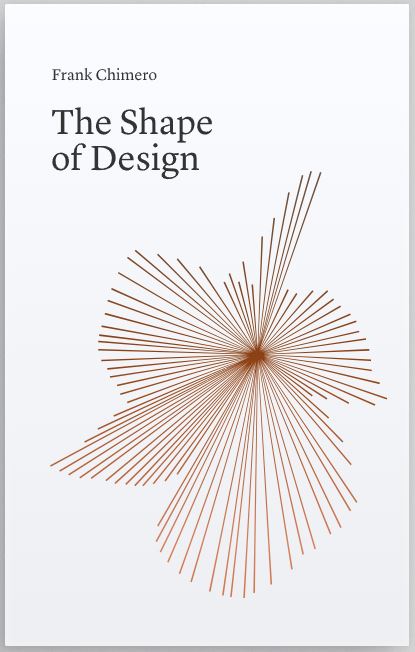
The Shape of Design is a short, accessible book about the creative process and the intersection of storytelling, craft and improvisation. The Shape of Design is a map of the road where we dance rather than a blueprint of it. It strives to investigate the opportunities of exploring the terrain, and it values stepping back from the everyday concerns of designing. … If you’ve read Frank Chimero’s essays or watched his talks online, you’ll recognise many of the ideas collected here. I’ve spent a year reading, re-reading, highlighting and annotating this book, and I’m sure I’ll keep coming back to it. If you work in design or a related field, and you think about what your work means and where it fits in the world, give this book a read.
The Shape of Design is a short, accessible book about the creative process and the intersection of storytelling, craft and improvisation. It strives to investigate the opportunities of exploring the terrain, and it values stepping back from the everyday concerns of designing. It attempts to impose a meaningful distance in order to patterns in the work and assess the practice as a whole. One can observe, from this distance, two very fundamental things about design that are easy to miss in the midst of all of this movement. First, design is imagining a future and working toward it with intelligence and cleverness. We use design to close the gap between the situation we have and the one we desire. Second, design is a practice built upon making things for other people. These two things dictate our relationship to the world and our bond to one another. They form the foundations of the design practice, so our work should revolve around these truths.
BOA posted a review of the book “Norman Foster: Net Works / Works”
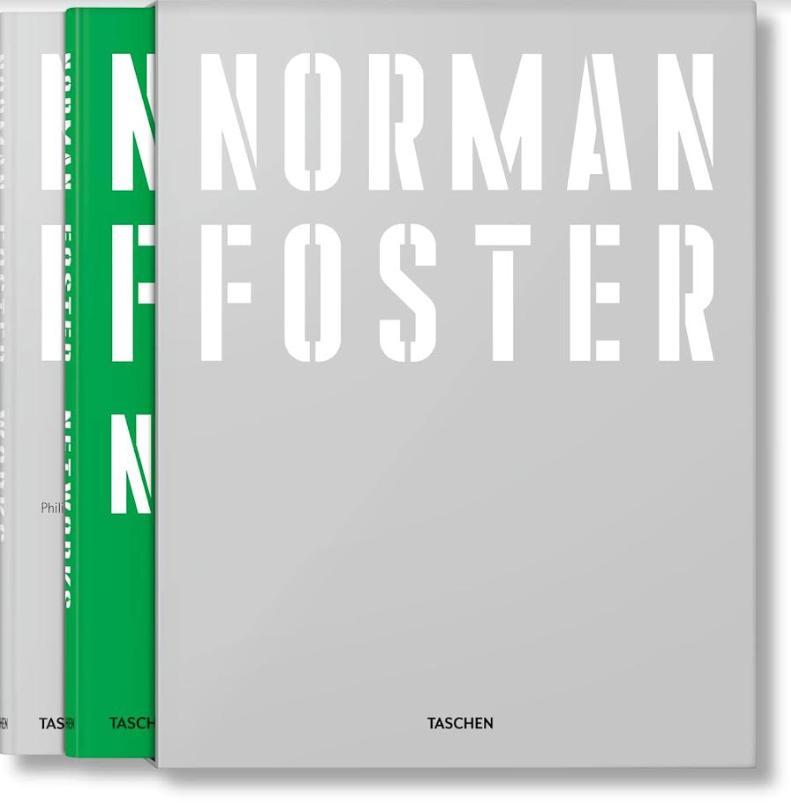
BOA posted a review of the book “Norman Foster: Net Works / Works”. This monograph explores Foster’s personal perspective on his work, his sources of inspiration, the connection between art and architecture, and how his passions, like his love for flying, influence his creations.
BOA has broadened its “Reading List” with “The History of Graphic Design: 1890-1959”
BOA has broadened its “Reading List” with “The History of Graphic Design: 1890-1959”, by Jens Muller and Julius Wiedmann. This book traces the development of this creative field, from its beginnings as poster design, to its later development into advertising, corporate identity, packaging and editorial design.
Norman Foster: Net Works / Works
Author: Philip Jodidio
Illustrator: Norman Foster
With a career spanning across continents and over six decades, the work of the renowned architect Norman Foster is nothing short of extraordinary. His creative innovation and holistic approach have made him one of the world’s most influential and well-known architects. From the Apple Park campus in Cupertino, California, to the Reichstag in Berlin, the enclosed court of the British Museum in London to the Millau Viaduct in France, with his practice of Foster + Partners, he has created celebrated landmarks that stand out for their inventive modernity and for what he calls “a sustainable approach to the design of the built environment.”
This is the first time Foster’s complete body of work has been published in one edition on such a grand scale. Giving a rare insight into the inner workings of his creative practice. It details his personal approach to his work, his inspirations, the link between art and architecture, and the significance and correlation between his passions, such as being an avid aviator, and his work.
The XXL monograph encompasses a lifetime of achievement and originality in two volumes. The first presents his architectural œuvre and is filled with numerous unpublished images and sketches handpicked by Foster from his archives. Paired with nearly 1000 illustrations, the second book contains eight essays he wrote explaining his sources of inspiration.
Aside from the 1999 Pritzker Prize, he has won the American Institute of Architects Gold Medal for Architecture, the Royal Gold Medal for Architecture, and the Gold Medal of the French Academy of Architecture. This is a magnificent visual journey not only through significant buildings of our time but also into the mind of a genius. Norman Foster sketched every page of this book and spent countless hours with the author and the graphic designer to make it one of the most remarkable architecture books ever published.
Also available as an Art Edition of 300 copies with a 1-meter-wide signed print of a drawing by Norman Foster, picturing the upcoming multifunctional community and business center InnHub in La Punt, Switzerland. The two volumes of this edition are collected in a custom-designed slipcase that folds into a book stand.
The History of Graphic Design: 1890-1959 by Jens Müller, Julius Wiedemann
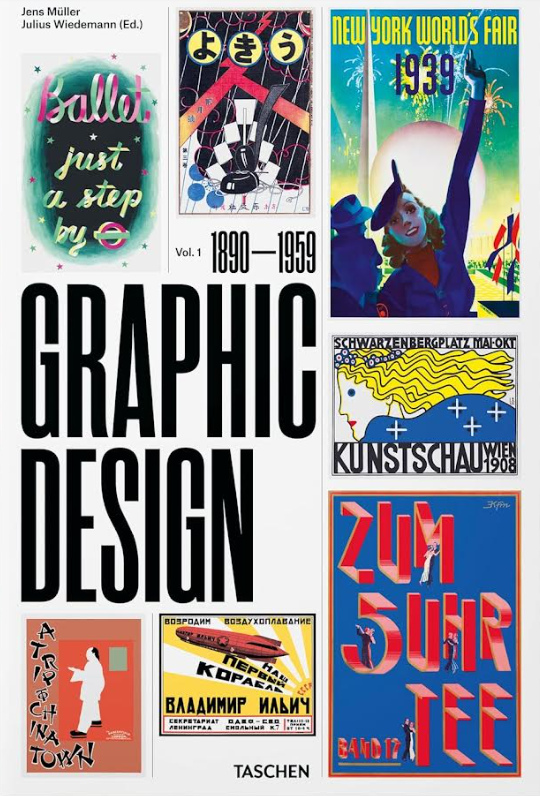
This book is an in-depth history of graphic design from the end of the 19th century to the ’50s. It traces the evolution of this creative field from its beginning as poster design to its further development into advertising, corporate identity, packaging, and editorial design. Organized chronologically, the volume features over 2,500 seminal designs from all over the world, 71 of which are profiled in detail besides 61 leaders in the field, including Alphonse Mucha (chocolate advertisements), Edward Johnston (London Underground logo and typeface), El Lissitzky (constructivist graphics), Herbert Matter (photomontage travel posters from Switzerland), Saul Bass (animated opening titles), and A. M. Cassandre (art deco posters).
Author Jens Müller curates the standout designs for each year alongside a running sequence of design milestones. Meanwhile, in his introductory essay, David Jury situates graphic design from its point of origin in early printing, engraving, and lithography to striking creative developments in the 19th century. Each consecutive decade is then prefaced by a succinct overview as well as a visual timeline, offering a vivid display of the variety of graphic production in each decade as well as the global landscape which it at once described and defined.
As we move on from and reflect upon the 20th century, this first volume examines the foundations of what would influence some of the fastest-changing creative fields. Combined with Volume Two—which spans from the 1960s until today—the tomes offer the most comprehensive exploration of graphic design to date and a long-overdue recognition of its enormous contribution to economics, politics, social causes, the arts, media, and the way we see the world.
Find out more about The History of Graphic Design: 1890-1959 by Jens Müller, Julius Wiedemann →
Update: BOA added 6 free video tutorials offered by Sinix Design
Update: BOA added 6 free video tutorials offered by Sinix Design
GLOBAL SOCIO-CULTURAL FUTURES

“Global Socio-Cultural Futures” is the second Course in the series on Global Systems designed for individuals and organisations committed to facing global challenges and finding solutions.
Course Content includes 12 Lessons across 3 Modules:
- City Futures
- Human Futures
- Educational Futures
There are two lessons in each, examining the challenges, and addressing the alternatives. This self-paced, web-based Course is incredibly well researched to give you a deep understanding of our emerging world and provides a solid basis for you to build your personal, professional, and family futures.
Why you should take this course:
- Learn from Professor Jennifer Gidley’s valuable expertise gained from 30 years’ experience as an international futures consultant at the highest levels of global thinking into the complexity and wide impacts of Climate Crisis, Energy Systems and Ecosystem collapse
- You will learn about rapid urbanisation and its social, cultural and environmental stresses; entrenched socio-cultural issues such as racism, gender inequality, and loss of meaning; and why the factory model of schooling is obsolete
- Be empowered to imagine, design and create social and cultural innovations such as ecological and smart cities; social and cultural practices that are empowering, equitable, inclusive, and meaningful; and educational approaches that are creative, evolutionary, integral, and transformative
- Learn how solutions offered align with the UN Sustainable Development Goals (SDGs)
- Receive a Certificate of Completion (Global Socio-Cultural Futures)
- Continuing Professional Development (CPD) – 30 Points
To enroll, please contact info@beopenfuture.com
The Youth Statement issued by the UNECE ESD Forum and the MED9 Forum captures the key contributions and perspectives of the young delegates

The UNECE ESD Forum and the MED9 Forum issued the Youth Statement, which captures the key contributions and perspectives of the young delegates, whose presence and active engagement were crucial during the special sessions. Their insights and energy provided a unique and vital perspective to the discussions, highlighting the importance of youth involvement in shaping a sustainable future..
The outcomes of these forums will play a significant role in shaping the discussions at the Summit of the Future, ensuring that the voices and ideas shared will have a lasting impact.