


BOA added 6 new online courses in Design from EduCBA
Author: JD
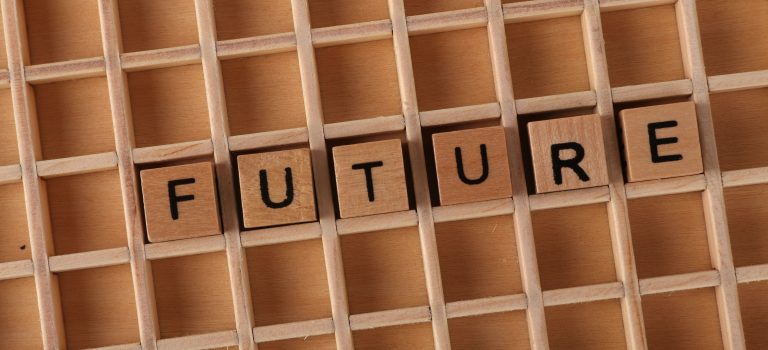
Futures Literacy: Why Creative Students Need to Learn How to Imagine Alternatives (Pt.1)
PART 1. From Prediction to Possibility
Design students are frequently asked to imagine the future. They develop concepts for future cities, future mobility, future materials, future learning and future ways of living. Yet many of these projects begin with an unexamined assumption: that the future is a destination waiting to be predicted and illustrated.
In reality, the future does not exist as a fixed place. It is shaped by choices, power, culture, technology, environmental limits and events that cannot be known in advance. What people imagine about the future influences what they invest in, what they fear, what they consider realistic and which alternatives they dismiss before they have been explored.
For artists, designers and architects, this makes imagination more than a creative gift. It becomes a form of responsibility. Students need to learn not only how to generate attractive visions, but how to question the assumptions behind them, compare different possibilities and recognise whose interests are represented in a proposed future.
This capability is often described as futures literacy: the ability to understand how images of the future shape decisions in the present, and to use alternative futures as tools for learning, questioning and invention.
The Future Is Not a Trend Line
A common way to design for the future is to extend a visible trend. If artificial intelligence is becoming more powerful, imagine a world in which AI is everywhere. If cities are becoming denser, design taller and more automated buildings. If consumption is becoming digital, assume that physical objects and public spaces will continue to disappear.
Trend awareness is useful, but trends are not destiny. They can accelerate, reverse, interact with other forces or produce resistance. A technology may become technically possible but socially rejected. A sustainable material may succeed in one region and fail in another because local infrastructure cannot process it. A service that appears convenient may create new forms of exclusion, dependency or surveillance.
When students treat the strongest current trend as the only future, they risk producing polished illustrations of the present rather than genuinely exploring change. Futures thinking begins when the brief opens from “What will happen?” to “What could happen, for whom, under which conditions, and what choices would move us towards or away from it?”
| BE OPEN Insight The future is not a destination waiting to be discovered. It is a creative material that shapes what we notice, permit and build in the present. When students learn to imagine more than one future, they become better at questioning the assumptions hidden inside today’s brief. Futures literacy is not an escape from reality. It is a way of seeing reality with more choice. |
Why Futures Literacy Is Becoming a Creative Skill
UNESCO describes futures literacy as a capability that helps people understand the role of the future in what they see and do. The central insight is simple but powerful: because the future does not yet exist, it can only be imagined. People can therefore become more skilled at recognising why they imagine particular futures and how those images affect action.
For creative students, this matters because every project contains an implicit future. A chair imagines how bodies will sit and how objects will be produced, maintained and discarded. A public space imagines who will feel welcome, who will move through it and how climate or technology may change its use. A digital service imagines future behaviour, data relationships, access and trust.
Futures literacy makes these assumptions visible. It encourages students to ask whether they are designing for continuity, transformation, breakdown, repair or an alternative that does not yet have a familiar name. It also helps them become more comfortable with uncertainty. The goal is not to remove uncertainty, but to use it as a space for inquiry rather than treating it only as a threat.
Case Study: UNESCO Futures Literacy Laboratories
Since 2012, UNESCO has supported Futures Literacy Laboratories as structured, learning-by-doing processes. Participants explore a topic they care about, uncover the hopes, fears and assumptions shaping their images of the future, and use collective intelligence to imagine alternatives.
The laboratory model is relevant to design education because it treats the future as something people learn to use, not something experts deliver as a forecast. Students can begin with an expected future, examine why it feels inevitable, and then create a contrasting or reframed future that reveals different possibilities in the present.
A studio could apply this method to the future of housing, food, mobility, work, care or creative education. The important outcome is not a correct scenario. It is a wider field of perception: students notice assumptions that had previously been invisible, identify new questions and become more willing to experiment.
Source:
https://www.unesco.org/en/futures-literacy/about
From One Future to Many Futures
The language of “the future” can be misleading because it suggests that only one outcome is approaching. Futures practice often uses the plural – futures – to remind us that different developments remain possible and that each possibility may be experienced differently by different people.
Students can distinguish between probable futures, which appear likely if current patterns continue; plausible futures, which could reasonably emerge under different conditions; possible futures, which stretch beyond familiar expectations; and preferable futures, which express values and desired directions. None of these categories is a prediction. Together, they help expand and organise imagination.
This plurality is especially important in creative education. A single future concept can hide trade-offs. A fully automated city may appear efficient while weakening privacy, informal work or human contact. A zero-waste product may reduce material use while becoming unaffordable. A digitally accessible museum may reach global audiences while excluding people with limited connectivity or different accessibility needs.
By comparing several futures, students can see that design decisions distribute benefits, risks and agency. The exercise becomes less about selecting the most spectacular image and more about understanding the consequences of different pathways.
Case Study: OECD Scenarios for Education
The OECD’s Trends Shaping Education 2025 uses alternative scenarios to support thinking about how education could develop. It distinguishes continuation, transformation and collapse scenarios and pairs them with fictional stakeholder stories. The scenarios are explicitly not predictions; their value lies in the discussion, critical thinking and reflection they generate.
This is a useful model for creative students. A future learning environment can be tested through the experiences of a student, teacher, parent, administrator or person excluded from the system. The same design may feel liberating to one stakeholder and restrictive to another.
Scenario work also encourages second-order thinking. If an AI tutoring platform becomes widely adopted, what happens to assessment, teacher identity, data ownership, inequality, motivation and informal learning? Looking beyond the immediate benefit helps students identify consequences that conventional problem-solving may miss.
Speculative Design as a Question, Not an Answer
Speculative design gives form to alternative futures through objects, services, images, environments and narratives. A speculative project may look like a product from another world, a museum label from 2040, an instruction manual for an unfamiliar social system or a service designed for needs that do not yet exist.
Its purpose is not necessarily to propose something that should be manufactured. The artefact acts as a question. It makes an abstract issue tangible enough to encounter, discuss and disagree with. A fictional object can reveal values and assumptions that remain hidden in a conventional essay or presentation.
For students, this changes the meaning of prototyping. A prototype can test more than usability or technical feasibility. It can test a social premise. What would it feel like to depend on an algorithm for access to housing? How might a family relate to an object designed to remain in use for four generations? What rituals might emerge in a city where water is more valuable than personal data?
Case Study: Dunne & Raby and the Design Imagination
Anthony Dunne and Fiona Raby have been influential in developing speculative and critical approaches to design. Their 2025 book Not Here, Not Now examines speculative thought, impossibility and the design imagination through projects that move between reality and fiction.
The value of the “impossible” object is that it interrupts the limits of the current brief. It can expose how commercial expectations, technological optimism or institutional habits narrow the range of futures designers are permitted to consider. By temporarily suspending the demand for immediate feasibility, students may discover questions that later lead to more grounded innovation.
However, impossibility is not an excuse for empty fantasy. A strong speculative project remains connected to present conditions. It shows which assumptions are being changed, what tension is being explored and why the alternative matters now.
Source:
https://mitpress.mit.edu/9780262049665/not-here-not-now/
Glitches & Glory: The Digitally Rewired Art of David Szauder by David Szauder
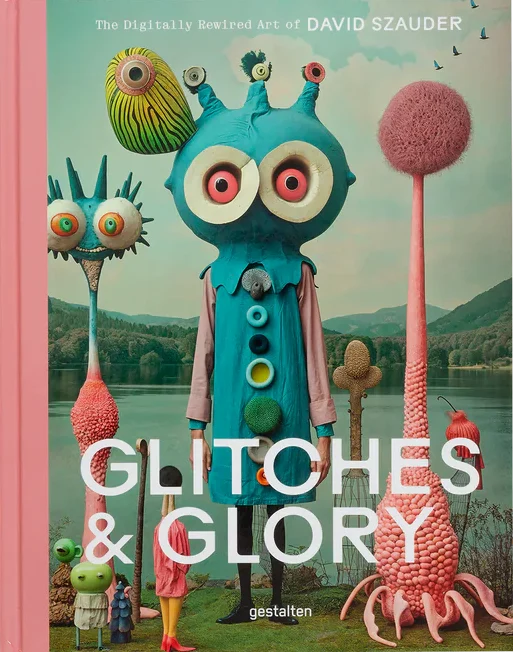
Glitches & Glory: The Digitally Rewired Art of David Szauder is a visually striking exploration of how digital errors, fragmented data and machine processes can become a distinctive artistic language.
David Szauder combines visual programming, generative techniques and image-making to create works that move between memory, identity and technological disruption. In his practice, the glitch is not simply a failure to be corrected. It becomes a creative event: an unexpected break in an image that reveals new structures, textures and ways of seeing.
For students interested in digital art, photography, graphic design, animation and generative media, the book offers both visual inspiration and a useful creative principle. New tools do not have to produce smooth, perfect or predictable results. Distortion, repetition, instability and technical accidents can be treated as material, allowing the artist to explore the relationship between human intention and computational behaviour.
This BE OPEN Pick brings an experimental digital perspective to the Bookshelf. It encourages young creatives to look closely at what happens when technology does something unexpected and to consider whether error can become authorship, whether damaged images can carry memory, and how the imperfections of machines may open space for a more personal visual voice.
Free download exhausted
Update: BOA added Glitches & Glory: The Digitally Rewired Art of David Szauder
BE OPEN Academy has added Glitches & Glory: The Digitally Rewired Art of David Szauder by David Szauder to its Bookshelf. The book explores how digital errors, fragmented data and machine processes can become artistic material, showing how glitches, distortion and technical accidents can open new visual approaches to memory, identity and technology.
How to Speak Machine: A Gentle Introduction to Artificial Intelligence by John Maeda
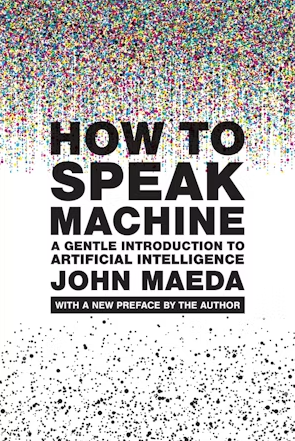
How to Speak Machine: A Gentle Introduction to Artificial Intelligence by John Maeda is an accessible guide to understanding artificial intelligence from the perspective of design, technology and human decision-making. Reissued in 2025 with a new preface, the book offers a clear framework for thinking about how machine-learning systems operate, what they can do and where their limitations begin.
Rather than treating AI as a mysterious technical force, Maeda explains why designers and other creative professionals need a working language for computation. The book considers the scale, speed and unpredictability of machines, while also asking how people can use these capabilities to create products and systems that are more inclusive, responsible and meaningful.
For students working across graphic design, product design, digital media, communication and creative technology, How to Speak Machine is a useful starting point. It does not require advanced coding knowledge. Instead, it encourages readers to approach AI with curiosity and critical awareness, recognising that the most important creative skill is not simply generating outputs, but understanding the assumptions, choices and consequences built into the tools we use.
Update: BOA added How to Speak Machine: A Gentle Introduction to Artificial Intelligence
BE OPEN Academy has added How to Speak Machine: A Gentle Introduction to Artificial Intelligence by John Maeda to its Bookshelf. Reissued in 2025 with a new preface, the book offers an accessible guide to how artificial intelligence and machine-learning systems work, encouraging designers and creative professionals to understand their possibilities, limitations and consequences.
Not Here, Not Now: Speculative Thought, Impossibility, and the Design Imagination by Anthony Dunne and Fiona Raby
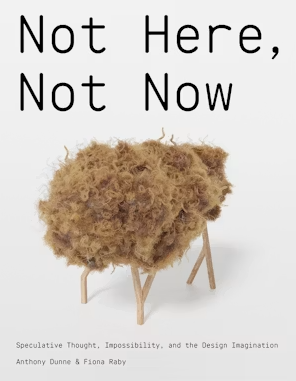
In Not Here, Not Now: Speculative Thought, Impossibility, and the Design Imagination, Anthony Dunne and Fiona Raby ask what design can do when familiar ideas of progress, prediction and problem-solving no longer feel sufficient.
The book moves between design, science, philosophy and literature to explore worlds and objects that are deliberately impossible, uncertain or incomplete. Through essays, images, imagined archives, glossaries and speculative artefacts, Dunne and Raby treat design not only as a way to produce solutions, but as a method for questioning the boundaries of reality and expanding what people are able to imagine.
For emerging designers, architects and artists, this is a challenging but valuable proposition. Creative education often asks students to respond to a brief, identify a problem and develop a plausible outcome. Not Here, Not Now creates space for a different kind of practice: one that uses fiction, ambiguity and impossible propositions to expose assumptions, resist predictable futures and discover questions that conventional methods may overlook.
At BE OPEN Academy, the book works particularly well as a deeper review because it connects speculative design with intellectual and cultural inquiry. It presents imagination not as an escape from reality, but as a critical tool for recognising that the present is only one possible arrangement of the world — and that design can help us perceive alternatives before they become practical or even fully thinkable.
Update: BOA added Not Here, Not Now: Speculative Thought, Impossibility, and the Design Imagination
BE OPEN Academy has added Not Here, Not Now: Speculative Thought, Impossibility, and the Design Imagination by Anthony Dunne and Fiona Raby to its Bookshelf. The book explores speculative design as a way to question assumptions, imagine alternative realities and use fiction, ambiguity and impossible propositions to expand the boundaries of design thinking.
Update: BOA added 8 video tutorials for Techniques in After Effects by SonduckFilm
BOA added 8 video tutorials for Techniques in After Effects by SonduckFilm
Impact Literacy: Why Creative Students Need to Learn How to Measure Change (Pt.2)
PART 2. From Outcomes to Learning
If impact literacy begins with evidence, it matures through learning. A responsible creative project does not only ask whether it succeeded. It asks what should be changed next time.
This is especially important for students, because educational projects are often experiments. A prototype may fail. A workshop may reach the wrong audience. A campaign may be misunderstood. A material may perform badly. A community partner may challenge the original brief. These are not necessarily failures if the student learns from them and adapts the project.
In this sense, impact measurement should not be treated as a final report written after the creative work is finished. It should be part of the design process itself: defining the problem, listening to people, testing assumptions, collecting feedback, observing use, reflecting on consequences and improving the next version.
Evidence Should Be Proportionate
One mistake students often make is thinking that impact evidence must be perfect or scientific in order to be useful. This can lead to two unhelpful reactions: either they overclaim impact without evidence, or they avoid discussing impact altogether because they cannot prove long-term change.
A better approach is to make evidence proportionate to the stage of the project. An early idea does not need the same level of proof as a funded programme delivered over several years. A student prototype may only need evidence that the problem is real, the audience has been consulted, and the concept produced a meaningful response in testing.
As the project matures, the evidence can become stronger: repeated feedback, comparison with earlier work, follow-up interviews, behavioural observation, partner validation, external recognition or data showing sustained use.
Case Study: Nesta Standards of Evidence
Nesta’s Standards of Evidence offer a useful model because they recognise that evidence should be appropriate to the stage of innovation. Early-stage projects may need to show a clear logic and early indications of change, while more advanced interventions require stronger evidence and, eventually, more robust proof that the intervention itself is causing positive impact.
For creative students, this staged approach is practical. A first-year project might only be able to explain its theory of change and collect early user feedback. A graduation project might include pre- and post-workshop surveys, prototype testing, documentation of participant responses and follow-up with collaborators. A long-term social design initiative might later require independent evaluation.
The principle is important: students do not need to claim more than they can prove. They need to show that they understand what kind of evidence is appropriate for the maturity of their work.
Source:
https://www.nesta.org.uk/feature/innovation-methods/standards-evidence/
Listening as Evidence
Impact literacy is not only about metrics. It is also about listening. In human-centred design, the people affected by a project are not abstract users or passive beneficiaries. They are sources of knowledge.
Interviews, group discussions, photo diaries, observations, co-creation sessions and prototype testing can all help students understand whether a project responds to real needs. These methods do not simply collect opinions. They reveal context, constraints, values, language and everyday realities that may be invisible from the studio.
The challenge is to listen ethically. Students should be clear about why they are collecting feedback, how it will be used, and whether participants have the opportunity to influence the project. Extracting stories from people without changing the design is not meaningful participation.
A good impact question might therefore be: what changed in the project because people were listened to?
Source:
https://www.designkit.org/methods.html
Case Study: Impact & Insight Toolkit
The Impact & Insight Toolkit, created by Counting What Counts in partnership with Arts Council England, provides evaluation tools for arts and cultural organisations. Its approach is based on helping organisations understand their own ambitions and progress, collect feedback from different groups of people and use that feedback to inform future creative planning.
This is a useful lesson for students because it treats evaluation as a learning process, not only a reporting obligation. Feedback is not gathered simply to prove that a project was good. It is gathered so that artists, designers and institutions can understand how people experienced the work and what might be improved.
For emerging creatives, this kind of thinking can be adapted at a smaller scale. A student exhibition, community workshop or digital project can include a simple feedback mechanism, short reflection questions and a plan for what will be done with what is learned.
Source:
https://impactandinsight.co.uk/
Designing Evaluation Into the Process
Evaluation should not be added at the end as an afterthought. If students wait until a project is complete, they may discover too late that they did not collect the information needed to understand its effect.
A more useful habit is to design evaluation into the process from the beginning. Before launching a project, students can define the intended change, identify who might experience it, choose a few indicators, decide how feedback will be collected, and plan when follow-up will happen.
The indicators should be simple and meaningful. For a sustainability project, they might include material avoided, reused or repaired. For an educational project, they might include skills gained, confidence increased or portfolio development. For a public art project, they might include participation, interpretation, dialogue or sense of belonging. For a collaborative project, they might include whether stakeholders felt represented and whether their input changed the outcome.
The goal is not to measure everything. The goal is to measure what matters for the claim being made.
The Role of Systems Thinking
Many creative projects operate inside complex systems. A design for reuse depends on supply chains, behaviour, maintenance and waste infrastructure. A public space project depends on governance, safety, climate, access and community trust. An educational platform depends on motivation, time, language, digital access and follow-up opportunities.
This means impact cannot always be attributed simply to one object or one intervention. Students need to understand contribution as well as causation. A project may contribute to awareness, confidence or experimentation without being the only reason change happened.
Design Council’s Systemic Design Framework is useful here because it asks designers to acknowledge complexity and interconnectedness, and to consider the structures and beliefs that underpin a challenge. It also expands the design process to include orientation, relationships, leadership, storytelling and continuing the journey.
For impact literacy, the phrase continuing the journey is especially important. A project’s effect often begins after the final presentation: when someone uses it, adapts it, shares it, rejects it, repairs it, learns from it or carries it into another context.
Source:
https://www.designcouncil.org.uk/resources/systemic-design-framework/
Impact in the Student Portfolio
If portfolios are becoming more process-led, impact evidence can become part of portfolio storytelling. A project page might include not only final images, but also the intended change, the audience, the feedback method, the evidence collected and the student’s reflection on what changed.
This does not mean every portfolio should become a research report. The evidence can be concise: a short theory of change, two feedback quotes, one before-and-after observation, a material flow diagram, a follow-up note, or a reflection on unintended consequences.
In an AI-assisted world, where polished visuals can be generated quickly, impact evidence helps reveal the depth of a student’s thinking. It shows that the designer did not only make an image or object. They considered what the work did in the world.
Ethics of Measurement
Impact measurement also has ethical risks. Data can be collected without consent, simplified too much, used to support exaggerated claims, or focused on what funders want rather than what communities need. Some forms of change are intimate, slow or difficult to quantify.
Students should therefore treat measurement with care. They should avoid turning people into evidence points. They should explain limitations, protect privacy, avoid overclaiming and remain open to negative or mixed results.
OECD’s evaluation criteria are useful reminders that impact is only one lens. A responsible evaluation may also ask whether a project was relevant, coherent, effective, efficient and sustainable. These questions encourage students to think beyond visibility and consider whether the work was needed, well aligned, well delivered and likely to last.
What Students Can Measure
Creative impact does not have to be measured through one universal framework. Different projects require different evidence. A useful starting point is to choose a small number of indicators that reflect the project’s purpose.
- Learning: new knowledge, skills, confidence, vocabulary or critical understanding.
- Practice: changes in material choices, design methods, collaboration habits or portfolio development.
- Access: who was able to participate, who was excluded, and what barriers were reduced.
- Engagement: quality of participation, depth of dialogue, return visits or sustained involvement.
- Environmental responsibility: materials reused, waste avoided, repair enabled or lifecycle extended.
- Professional progression: exhibitions, commissions, grants, publications, collaborations or further study following participation.
- Community value: whether participants felt represented, listened to, respected or able to influence the outcome.
- Learning from failure: what did not work, what was changed and what should be tested next.
Key Takeaways for Design Students
- Do not confuse visibility with impact.
- Distinguish outputs from outcomes.
- Define the change you hope to create before choosing what to measure.
- Use a simple theory of change to make your project logic visible.
- Collect evidence that is proportionate to the stage of your work.
- Combine numbers with stories, feedback and observation.
- Listen to the people affected by your project, and show how their input changed the work.
- Be honest about uncertainty, limitations and unintended consequences.
- Include impact evidence in your portfolio when it strengthens the story of the project.
- Remember that measurement is not only for proving success. It is for learning how to do better.
Looking Ahead
The future of creative education will not be defined only by technical skill, visual originality or the ability to work with new tools. It will also be defined by responsibility: the ability to understand how creative work affects people, materials, systems and futures.
Impact literacy gives students a language for that responsibility. It helps them move from broad claims to thoughtful evidence, from good intentions to learning, and from isolated outputs to longer journeys of change.
This does not mean that art and design must become instrumental, predictable or easily measured. The most powerful creative work often opens questions rather than closes them. But even open-ended work can be reflected on carefully. It can ask who encountered it, what it made visible, what relationships it created, what possibilities it opened and what should happen next.
For young creatives, learning to measure change is not a departure from imagination. It is a way of protecting imagination from empty claims. It allows them to show not only that their work is beautiful, inventive or urgent, but that it has entered the world with attention, humility and consequence.
The next generation of artists, designers and architects will need to create. They will also need to listen, follow up, learn and prove where proof is possible. In a world facing complex social and environmental challenges, impact literacy may become one of the most important creative skills of all.